
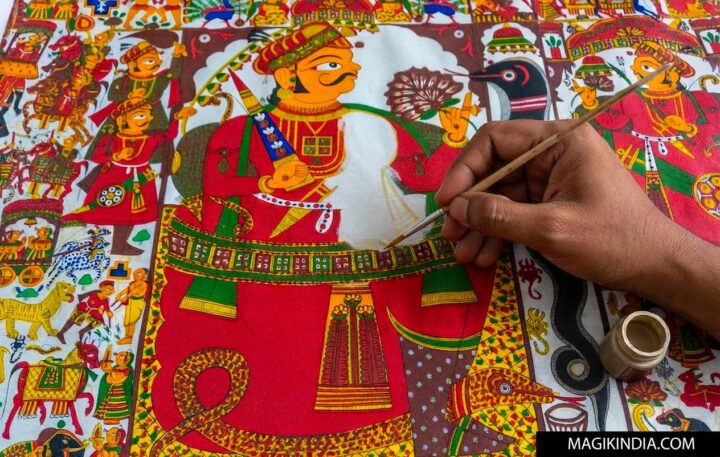
Phad is one of India’s most fascinating artistic and cultural expressions. Originating from the district of Bhilwara and more particularly from the town of Shahpura in Rajasthan, this traditional art unites painting on a fabric scroll, epic narration, music and popular theater. A true nomadic temple, the Phad is both a visual masterpiece and a …

Lost in the middle of the tumultuous currents of the Brahmaputra, the island of Majuli is a world apart. As a land of contrasts, it unites the authenticity of tribal traditions with the artistic influence of the Satras, these monasteries which perpetuate a centuries-old culture through dance, masks and prayer. Despite the constant erosion that …

The Mata ni Pachedi, literally “the goddess in the background,” is the triumph of fervour over exclusion. Invented by the Vaghari nomads, deprived of temples, this textile art made cotton canvas the nomadic sanctuary of the Mother Goddess. More than a “Kalamkari of Gujarat”, it is a painted prayer, a beauty born on the margins which …

Imagine a kitchen utensil capable of rivaling Teflon, yet born of the earth, long before the industrial era. Deep within the dense forests of Chhota Udepur, in Gujarat, the Dhanak community jealously guards an ancestral secret: lacquered pottery. Here, tribal ingenuity outpaces modern technology to offer a healthy, eco-friendly, and naturally non-stick way of cooking.
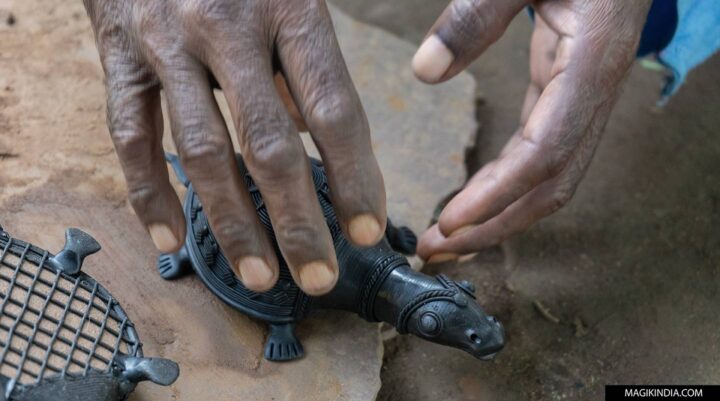
Some forms of art do not merely traverse time; they suspend it. Deep within the tribal strongholds of India, where the forests of Chhattisgarh and Odisha still whisper tales millennia old, Dhokra survives. A living vestige of the Indus Valley Civilization, this craft has perpetuated the metaphysical process of “lost-wax casting” for 4,000 years. A …

Situated between Jaipur and Agra, Abhaneri, the ancient “City of Brightness” (Abha Nagri), is a historical treasure. Its heritage rests upon two 9th-century CE marvels: the ingenious Chand Baori, a colossal stepwell and true feat of stone engineering, and the Harshat Mata Temple, whose carved ruins whisper of the fervor and finesse of medieval Indian …

Nestled at the foot of the Aravalli Mountains in the peaceful Pali district, the village of Ghanerao is an invitation to travel back in time. Once a powerful princely “thikana,” located on the strategic border of Mewar and Marwar, this little-known corner of Rajasthan offers a peaceful escape off the beaten track. It’s the perfect …
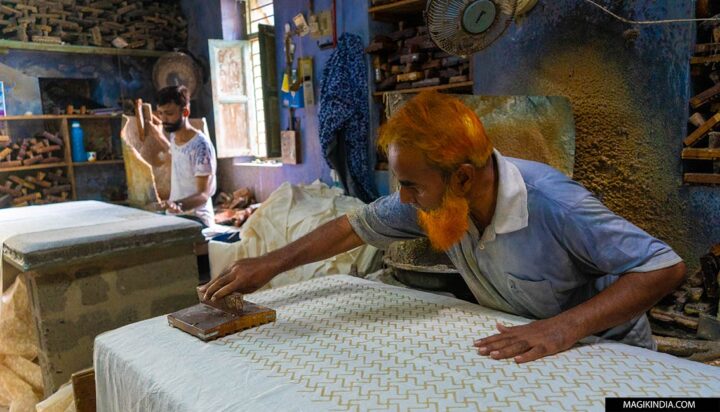
Batik is among the most vibrant textile arts of Kutch, alongside ajrakh, bandhani, and the distinctive embroideries of the Ahir, Rabari, and Mutva communities. This art, woven into the very fabric of Kutch’s land, is a profound mirror of its history and the ancient trade routes that have shaped its identity.
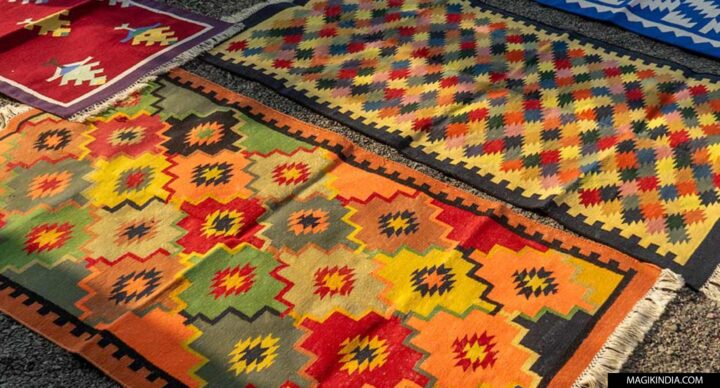
In an India undergoing constant transformation, where ancestral traditions are gradually giving way to rampant modernity, the village of Salawas, nestled on the outskirts of Jodhpur in Rajasthan, embodies a silent resistance. Here, dhurries, flat hand-woven rugs, are much more than simple decorative objects: they are the living reflection of ancestral know-how passed down from …
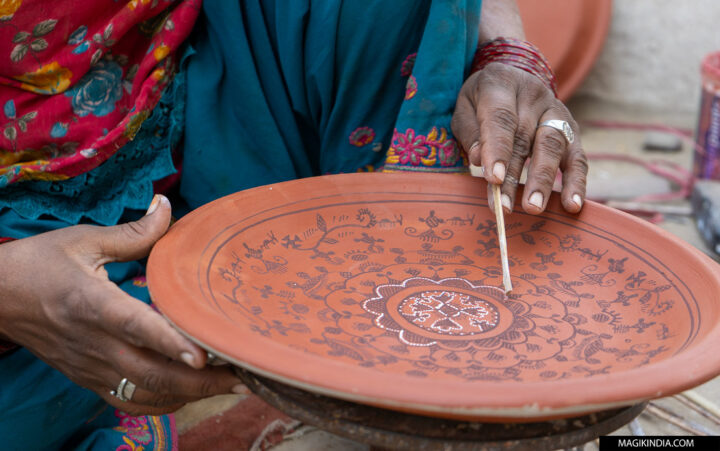
In the north of the district of Kutch (Gujarat), on the edge of the great white desert, is the village of Khavda which gave its name to a very specific ceramic, whose origins date back to the thousand-year-old civilization of the Indus Valley. While the art of pottery from this region has survived since the …

