

If Gujarat captivates me, it is above all by the human richness of its communities. After exploring the world of...
The Baiga: the people who refuse to harm the soil
The Baiga tribe, nestled deep within the dense forests of northern Chhattisgarh, define themselves above all as the spiritual guardians of a land they refuse to harm. This devotion to the nurturing earth is matched by a profound expertise: the Baiga are masters of forest pharmacopoeia and healers whose botanical knowledge allows them to transform every root and piece of bark into an ancestral remedy. Between their bodies adorned with eternal tattoos and their science of plants, the Baiga do not merely inhabit the forest; they are its living memory and its protective breath.
A people born of the earth
Originating from the Munda lineage, the Baiga rank among the oldest Adivasi (indigenous peoples) of Central India. Long before the arrival of the Gond or Aryan populations, they already inhabited the Satpura ranges. Today, this people known as “guardians of the forest” lives at the heart of a zone of dense biodiversity, spread across the mountainous plateaus of the Maikal Range, on the border between Madhya Pradesh and Chhattisgarh.

While science links them to India’s Austro-Asiatic roots, the Baiga soul draws its source from a far more mystical narrative: they descend from Nanga Baiga (the Naked Baiga) and Nangi Baigin (the Naked Baiga woman), the Indian Adam and Eve, fashioned by the deity Bada Dev. Legend has it that, by refusing the plow offered by God so as not to “tear the bosom of Mother Earth,” the first couple received in exchange dominion over the jungle and the secret of medicinal plants.
From nomadism to forced sedentarisation
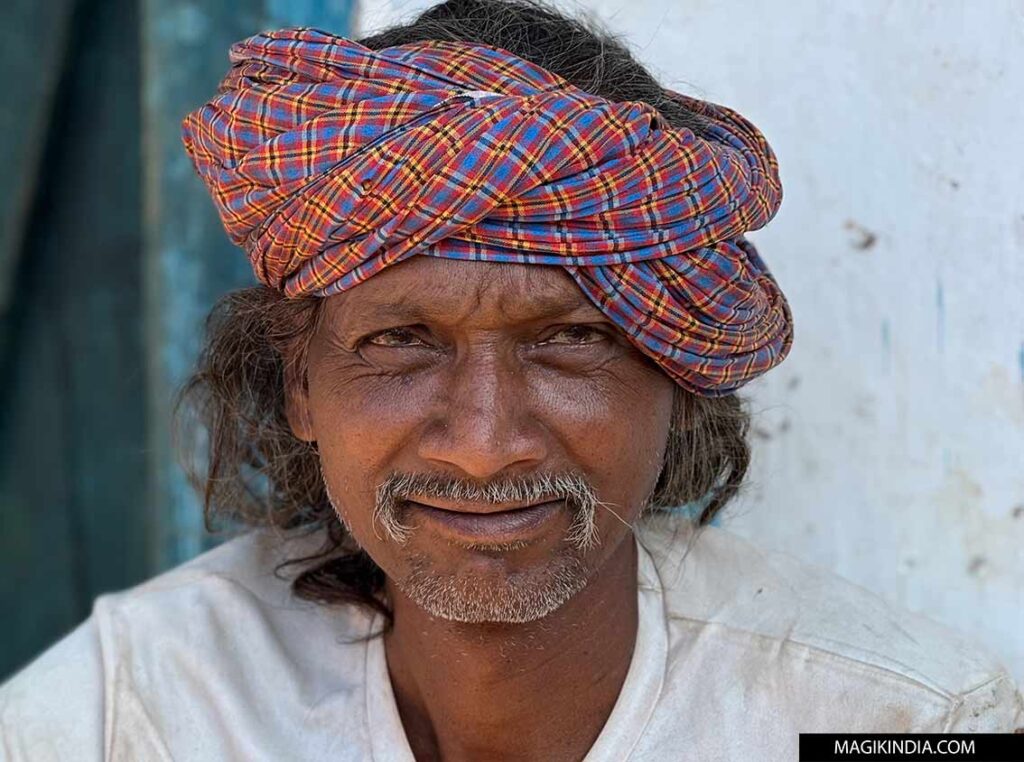
True to the pact of Bada Dev, the Baiga consider plowing a sacrilege, preferring Bewar (slash-and-burn cultivation) instead to preserve the integrity of Mother Earth. This self-sufficient way of life—practiced for millennia in the Narmada and Tapti valleys shattered in 1890 in the face of British colonisation.

To exploit the timber from the sal forests, the Raj imposed a brutal policy of forced sedentarisation, corralling thousands of families into the Baiga Chak, a reserve of just 100 square kilometers in the Dindori district (Madhya Pradesh). This confinement, maintained even after independence, all but extinguished their ancestral nomadic way of life by the 1950s. Today, only a few pockets of resistance in Chhattisgarh (in the Bilaspur and Kawardha districts) still keep alive the last vestiges of the original Bewar.
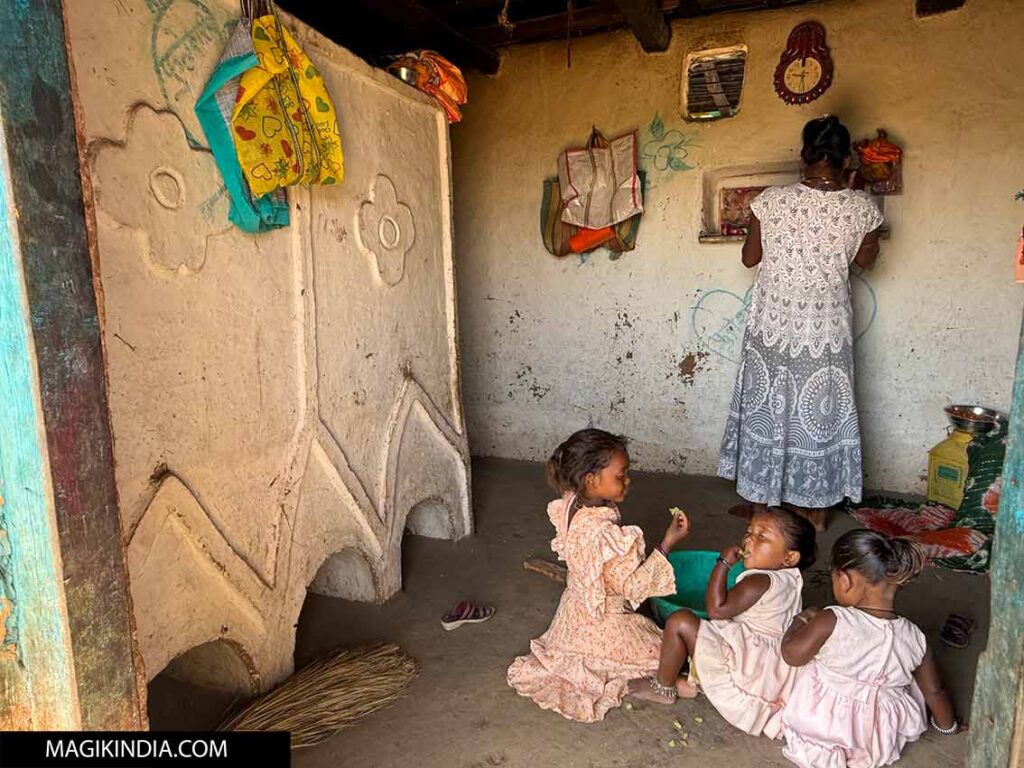
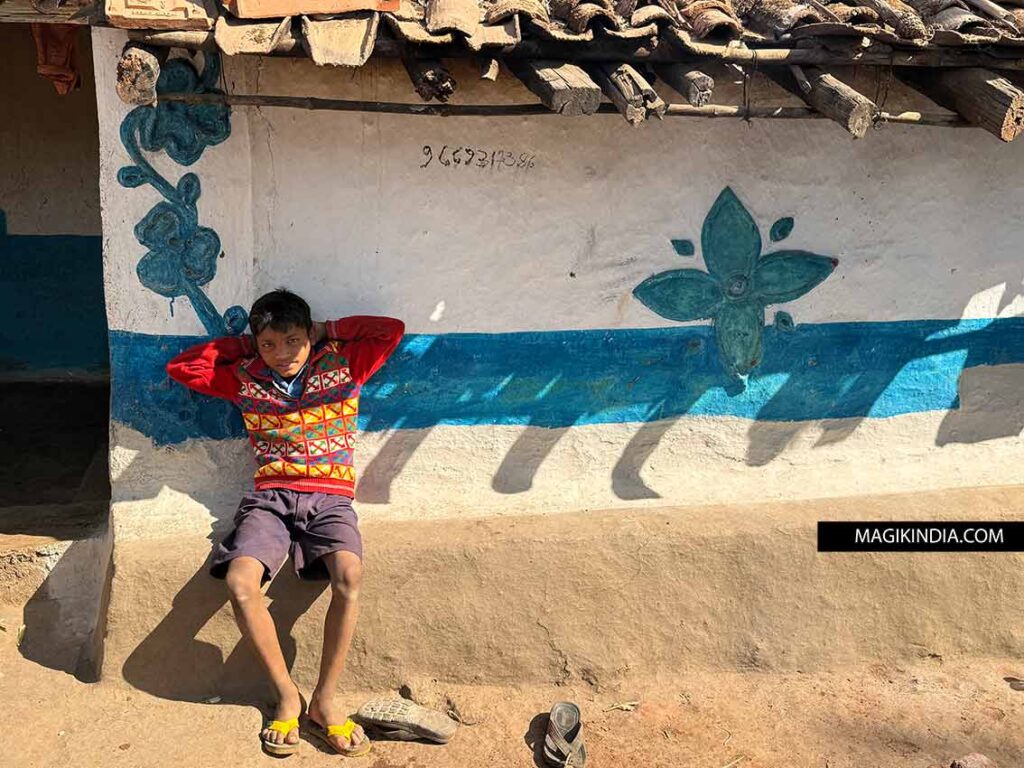
Having become sedentary farmers, the Baiga transposed their worldview into the architecture of their new villages. The aesthetics of traditional Baiga dwellings are thus grounded in a chromatic code in which lime-white known as chuna stands out as the color of purity and freshness.

Added to this immaculate background is the sky blue that adorns the facades of the most traditional clans. This colour directly associated with the deity Bada Dev (the heavens) functions as a visual talisman, warding off diseases and hostile spirits to harmonise the dwelling with the invisible realm.

The forest Healers
Historically dwelling in the shadows of the Gond kingdoms, the Baiga were nonetheless their spiritual pillars. As royal priests and legendary shamans, they embodied mystical authority in the eyes of the sovereigns of Mandla and Ratanpur. This nobility of spirit is rooted in their very name: the “Vaidyas”, that is to say, “supreme healers.”

Thanks to their in-depth knowledge of the flora, the elders have a complete mastery of the forest’s resources. This expertise makes the Baiga an indispensable reference for neighboring populations.
The tattoos of Baiga women
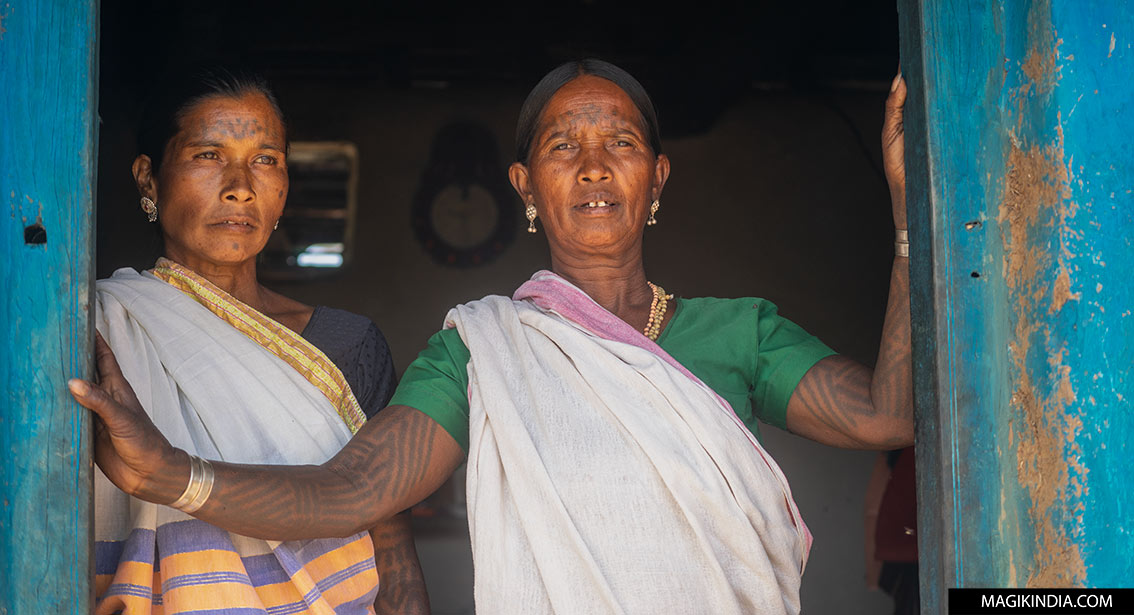
The art of godna (tattooing) is a visual signature inseparable from the Baiga identity, yet its extent varies according to the tribe’s clan lineages. For some clans, tattooing is limited to symbolic motifs on the forehead; for other lineages, tradition demands an almost complete covering of the body. From arms to legs spanning the back and chest the skin becomes a complex geometric fresco.
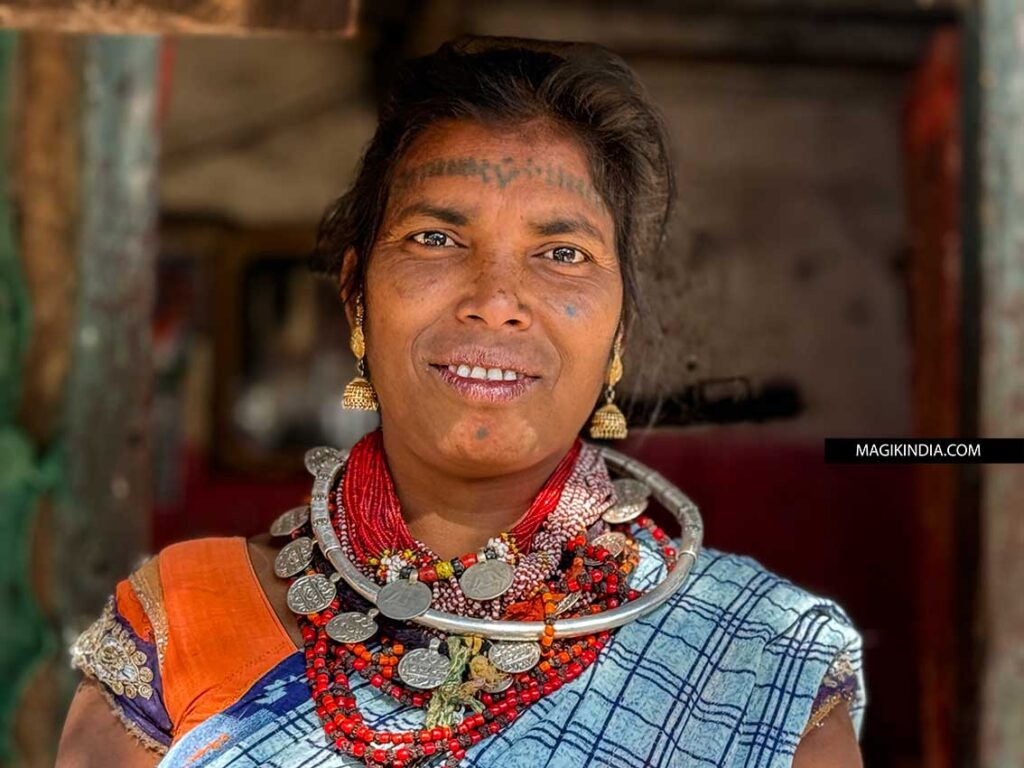
The ritual journey of a Baiga woman begins at the age of eight with a forehead tattoo centered around a transverse line. On either side, vertical strokes reach out like roots or branches, offering a stylized evocation of the primeval forest that permeates their cosmogony.

Then, three distinct points trace the trajectory of existence, marking the passage from youth to maturity, and finally to old age. Finally, at the heart of this composition, a V-shaped form centered on a single point embodies the chulha: the sacred fire of the hearth.

Within certain Baiga clans, a woman’s entire body becomes a living canvas, with each motif marking a specific stage of her existence. This journey begins in adolescence with the tattooing of the back, laying the initial foundations of adult identity. Once this area has healed, the work continues on the legs.
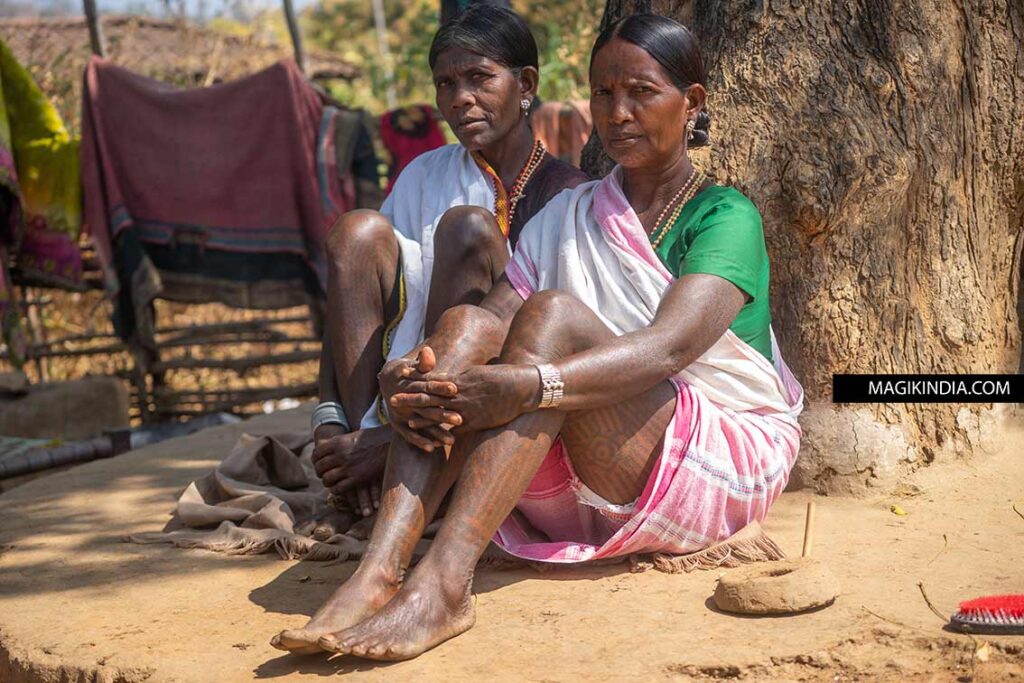

The cutaneous narrative then extends to the arms, prolonging the geometric designs to the extremities before reaching its climax with motherhood. It is only after the birth of the first child that the chest is finally adorned, definitively sealing the status of mother through this final act of resilience.

Beyond the Baiga community alone, this ancestral art of tattooing is gradually fading from India’s tribal landscapes, taking with it the last witnesses of an identity etched into the skin, a fading identity facing a modernity that homogenises bodies and cultures.
Traditional dances and costumes
The Baiga wardrobe favors hand-woven raw cotton. The centerpiece for women is the lugra, a white or pink draped garment that falls just below the knee. Crossed over the shoulder, it is designed to facilitate freedom of movement. The use of the choli (blouse) reflects modern standards of modesty, as Baiga women traditionally did not wear one. As for the men, they embrace a functional minimalism: the panchi (cotton loincloth) or a colourful dhoti, sometimes complemented by a jacket and a scarf.

While sobriety dominates daily life, the effervescence of festivals radically transforms the appearance of community members: dance costumes then burst forth in a whirlwind of color and ritual sophistication.
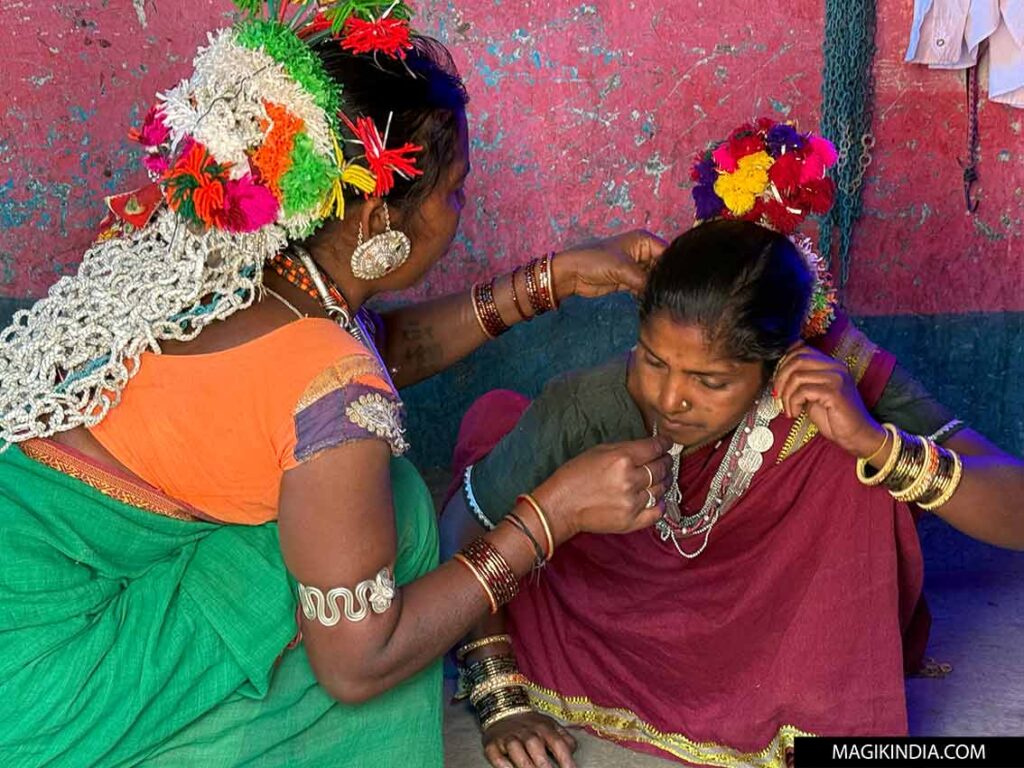
During festivals, Baiga women layer vibrant fabrics, knotted at the front, over a shimmering sari. Yet it is their hairstyles that truly capture the eye: from their hair buns bloom flamboyant pompoms and fan-like structures, evoking floral explosions or the majestic wheel of a peacock.
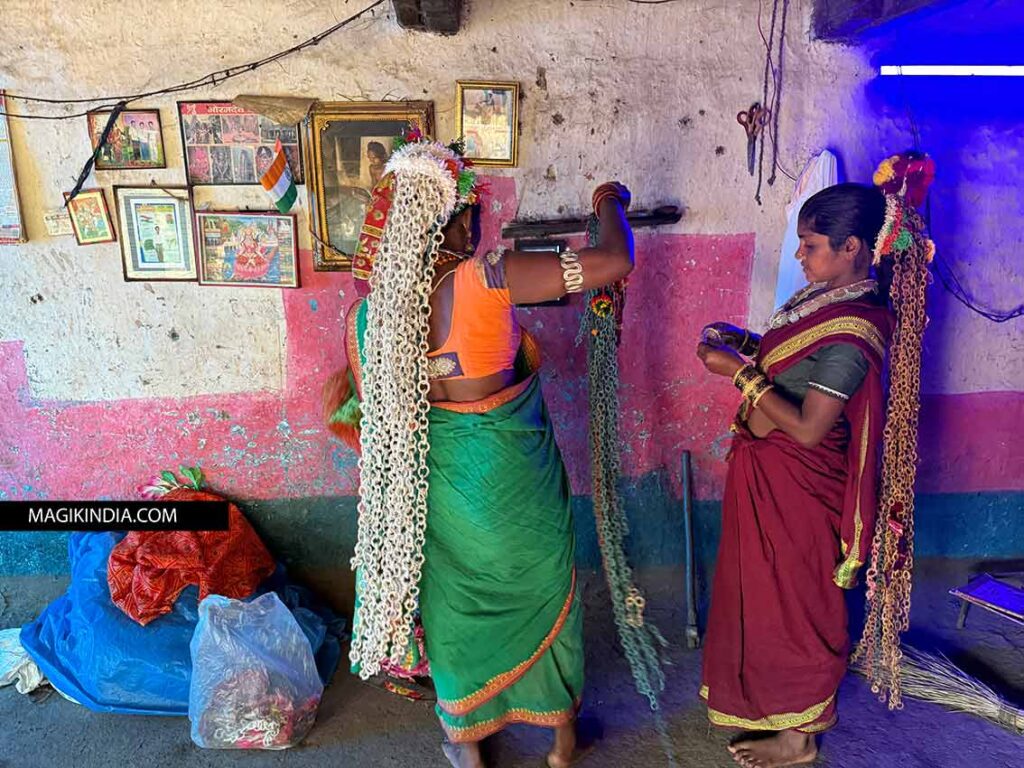
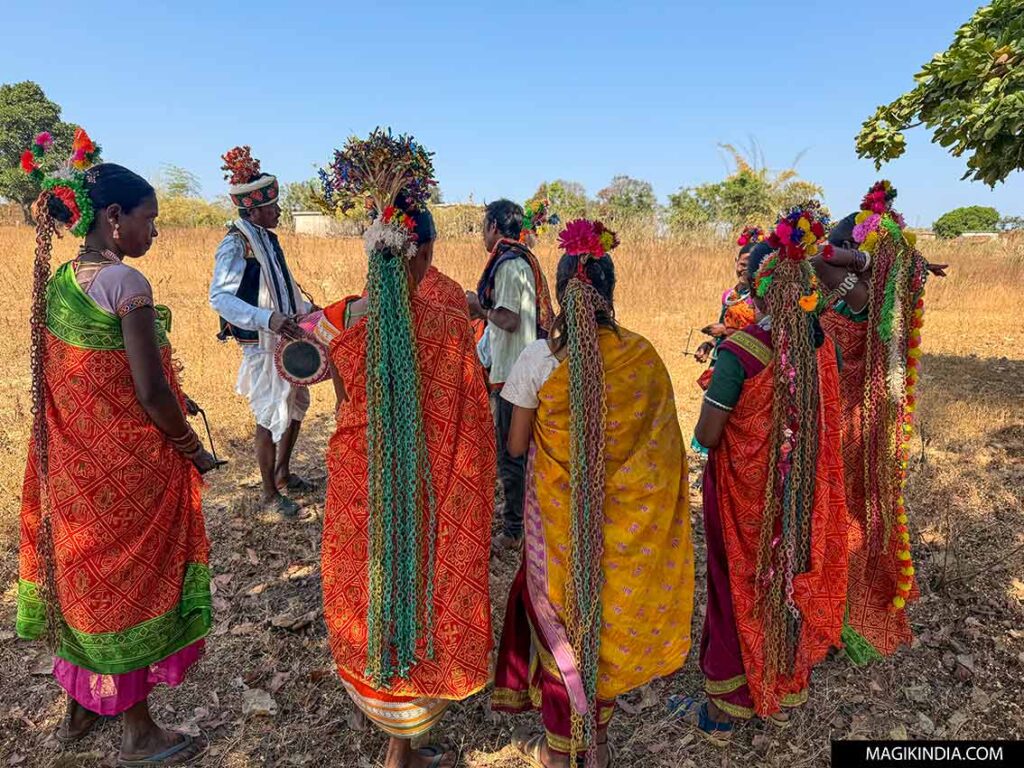
The most fascinating feature remains this long train cascading down the back, an adornment I was seeing for the very first time. It consists of a succession of interlocking rings made of cotton or tree bark, creating a fluid movement that accompanies every dance step.

For anyone passionate about anthropology, witnessing these choreographic rituals, whether spontaneous or staged, goes far beyond mere folklore. It is a rare immersion in which astonishing analogies are revealed between the sacred gestures of India and those of indigenous peoples across the globe.
These invisible bridges underscore that music and dance constitute a primal language and a universal human heritage that defies borders. In this space of encounter, the exchange becomes a “win-win”: the visitor is enriched by ancestral wisdom, while the community, by sharing its art, reaffirms the vitality and pride of its cultural identity.
MEETING THE BAIGA TRIBE IN CHHATTISGARHVous aimerez peut-être aussi...

The Santhal people constitute one of India's largest indigenous communities, primarily settled in the states of Jharkhand, West Bengal, Odisha,...
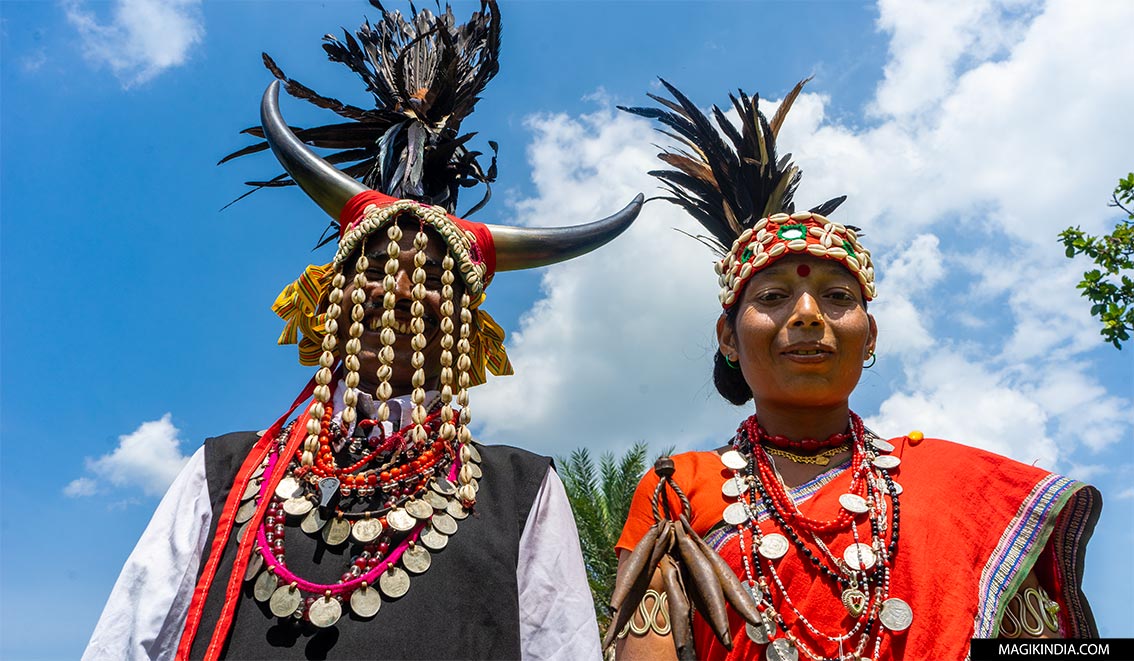
Inhabiting the high plateaus of Bastar (Chhattisgarh), the Dandami Maria tribe constitute an emblematic branch of the Gond people, distinguished...

The Muria tribe, a major branch of the Gond ethnic group, inhabits the highlands and forests of the Bastar district...
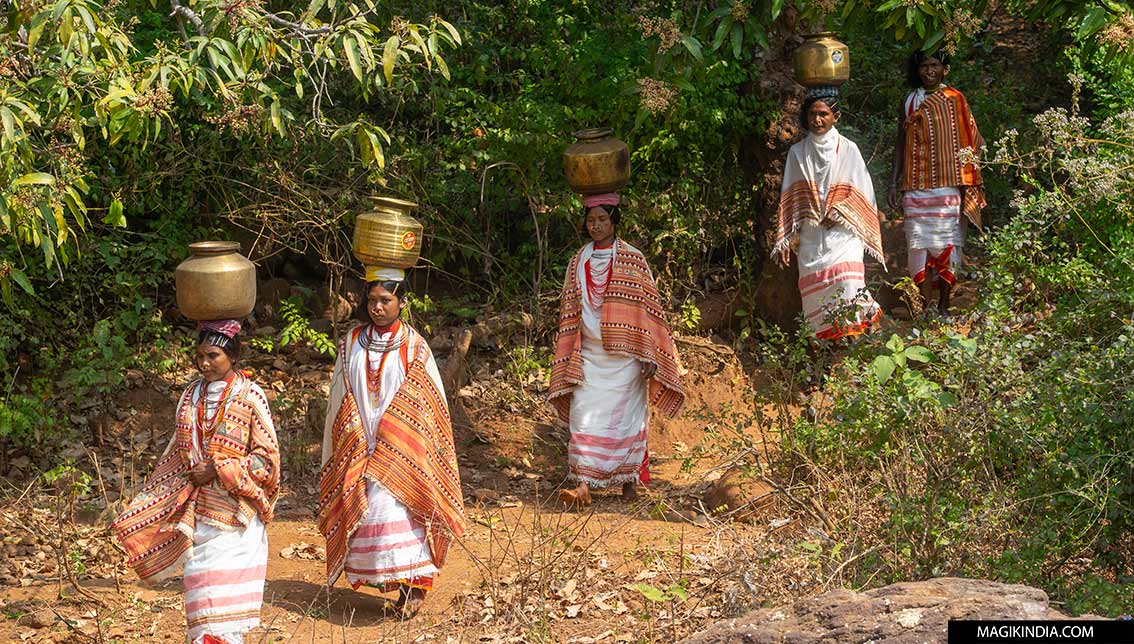
Nestled within the rugged terrain of Odisha’s Niyamgiri Hills, the Dongria Kondh cultivate a sovereign elegance that finds expression as...
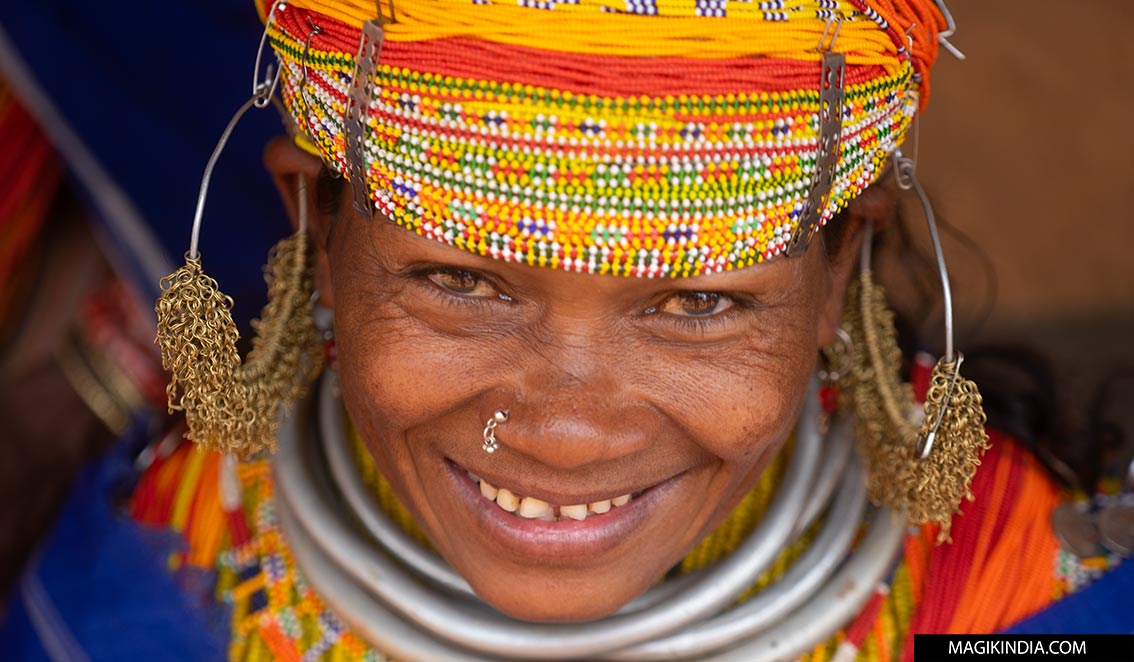
Nestled within the rugged folds of the Malkangiri district, on the fringes of the state of Odisha, lives the fascinating...

