

Situated in the vast expanses of Rajasthan, halfway between Udaipur and the Pink City, Shahpura cultivates the art of discretion....

The Art of Dhokra: The Adivasi Millennia-Old Bronze
Some forms of art do not merely traverse time; they suspend it. Deep within the tribal strongholds of India, where the forests of Chhattisgarh and Odisha still whisper tales millennia old, Dhokra survives. A living vestige of the Indus Valley Civilization, this craft has perpetuated the metaphysical process of “lost-wax casting” for 4,000 years. A true relic of the Bronze Age, shaped by tribal hands, Dhokra continues with a raw grace to defy the standardisation of the modern world.
A true feat of artisanal engineering practiced for over 4,000 years in India, the Dhokra technique relies on the “lost-wax” process. Unlike industrial methods, this tribal art emblematic of the states of Odisha, Chhattisgarh, and West Bengal is based on a “single-mould” process in which each mould is destroyed to release the finished piece.

This age-old expertise of which the famous “Dancing Girl of Mohenjo-daro” (c. 2500 BC) remains the most illustrious testament proves that the mastery of this complex foundry technique dates back to the very roots of the Indus Valley Civilisation.
The Core : The Soul of Dhokra
Unlike massive sculptures, a Dhokra piece is distinguished by its internal void, structured around what is truly called its “soul”: the clay core. This primordial matrix forever imprisoned within the heart of the metal stands as the invisible witness to the creative process; indeed, when handling an authentic statuette, one often perceives a faint rattling sound. These are the fragments of that calcined earth which, having survived the ordeal of fire and fusion, continue to resonate within the finished work.

The core of Dhokra relies on an alchemy of natural materials, carefully selected for their technical properties. River clay forms its malleable structure, yet it could not, on its own, withstand the thermal shock of the foundry.

To prevent cracking during drying or firing, artisans incorporate rice husks or sand, which act as essential structural binders. Finally, the addition of cow dung provides indispensable organic cohesion: as it burns, it creates a subtle porosity within the clay, allowing gases to escape without causing the mould to explode when the molten metal displaces the wax. At this stage, fine detail is not the objective; the core is merely a slightly smaller and “rougher” version of the final piece.

Wax Threading
The threading stage constitutes the absolute aesthetic signature of Dhokra, transforming a rough blank into a work of art of incomparable graphic finesse. Once the clay core is perfectly dry, the artisan does not sculpt the material, but rather literally clothes it in threads of wax.

To create the iconic threads of Dhokra, the artisan heats resin or wax over a flame until it reaches a malleable consistency, then inserts it into a cylindrical metal press. Under manual pressure, the material flows through fine orifices, forming strands resembling black spaghetti.

While beeswax remains the quintessential noble material, a resin derived from the Dammar (or Sal) tree is often preferred. This traditional “tar”, which bears a resemblance to petroleum products in name only is, in reality, a blend of resin and vegetable oil. Once heated, this mixture transforms into a malleable black paste, offering thermal resistance that is indispensable under the scorching Indian sun. It enables the crafting of intricate pieces without the risk of deformation prior to firing.

However, faced with the scarcity of natural resin, or simply for the sake of convenience, some artisans today are turning to industrial bitumen: an economical alternative, yet one that is not eco-friendly and which, unfortunately, threatens the original finesse of this ancestral art.
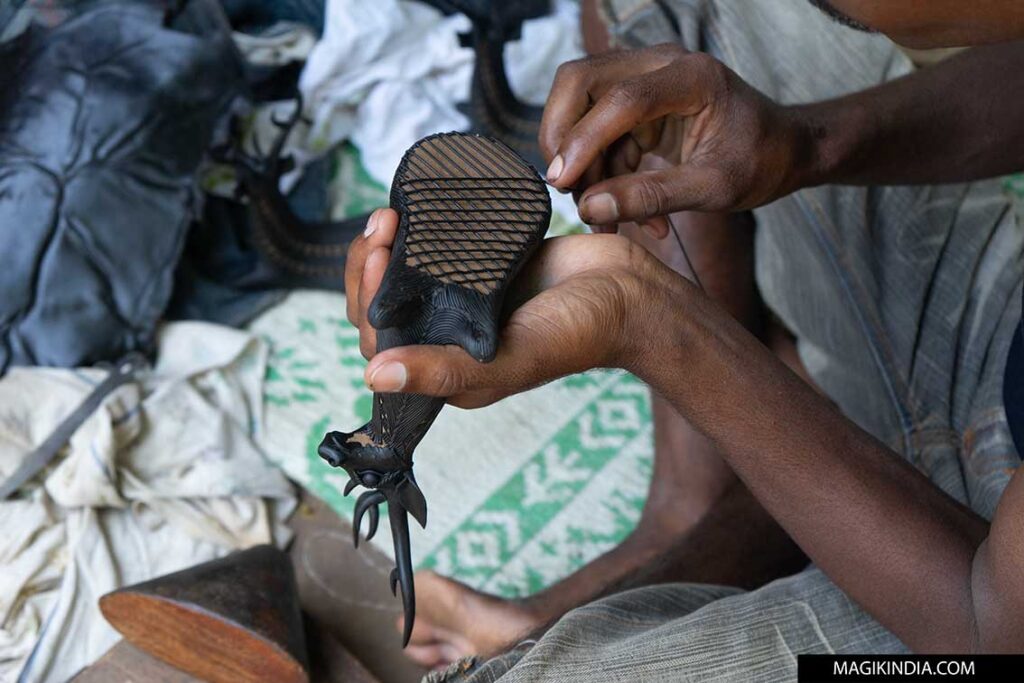
These wax “spaghetti” strands are then arranged with infinite delicacy upon the clay core. It is during this crucial stage that the final design takes shape, a goldsmith-like feat demanding extraordinary craftsmanship and absolute patience to breathe life into the intricate motifs of Dhokra.
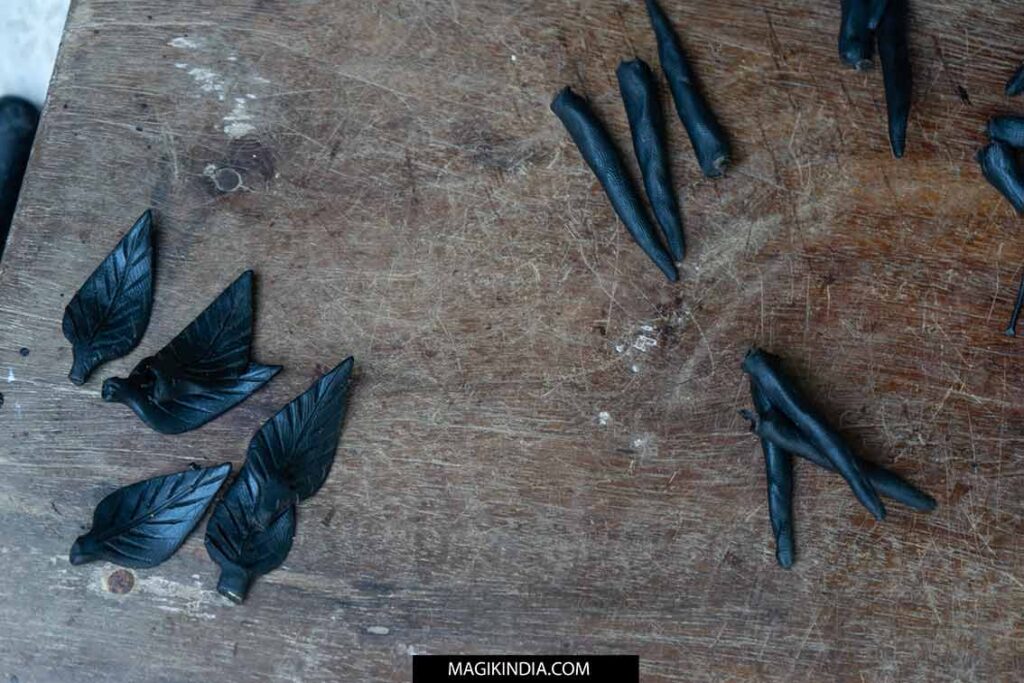
Finishing touches such as eyes, adornments, and ornamental motifs are applied by pressing tiny fragments of wax onto the piece. Each detail is individually modelled, lending relief and character to the form prior to the casting stage.

Each region of India where Dhokra craftsmanship endures possesses its own distinct stylistic identity. While some localities specialise in the intricate finesse of small, finely chiseled pieces, others distinguish themselves through truly monumental masterpieces. This is notably the case in Gunupur (Odisha), where artisans craft horses and anthropomorphic figures of remarkable scale, pushing the boundaries of lost-wax casting.

The Dhokra Coating and Reservoir
Once the artisan has completed the delicate covering with wax threads, the object must be prepared for the trial by fire. This stage known as encasing and reservoir creation consists of transforming a wax sculpture into an airtight foundry mould.

The artisan coats the entire piece (the core clad in wax) with an extremely thin layer of clay, followed by several thicker layers. The initial layer of slip must conform to every interstice of the wax threads without trapping any air bubbles. It is this clay that will capture the perfect negative impression of the ornamentation.
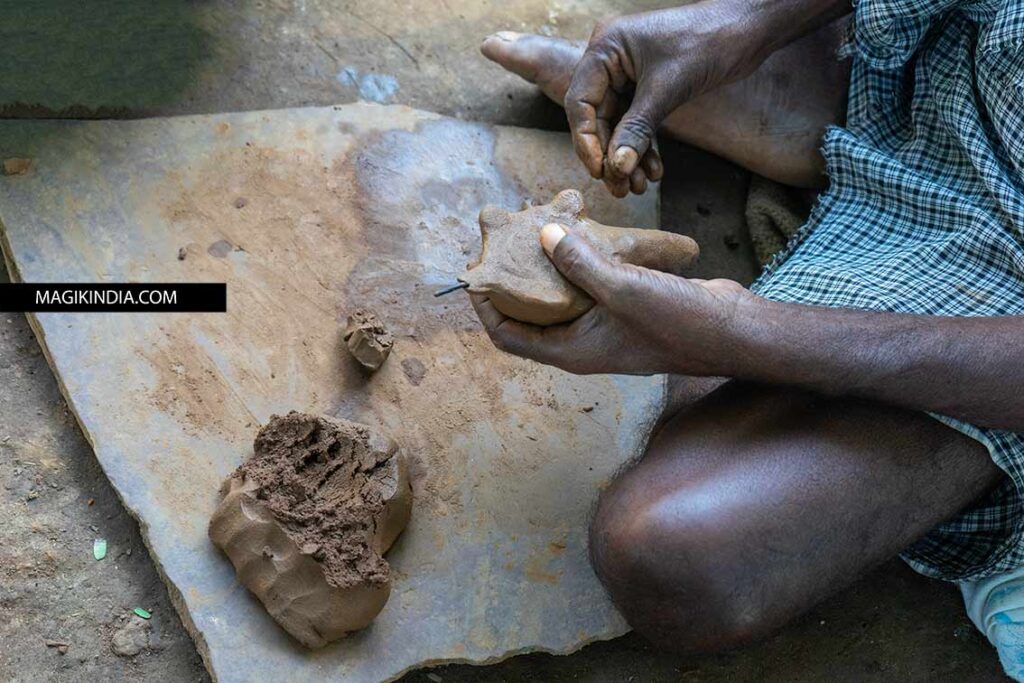
The successive layers, often reinforced with fibers or sand, form a robust shell capable of containing the pressure of the molten metal and maintaining the overall structure despite the extreme temperatures.
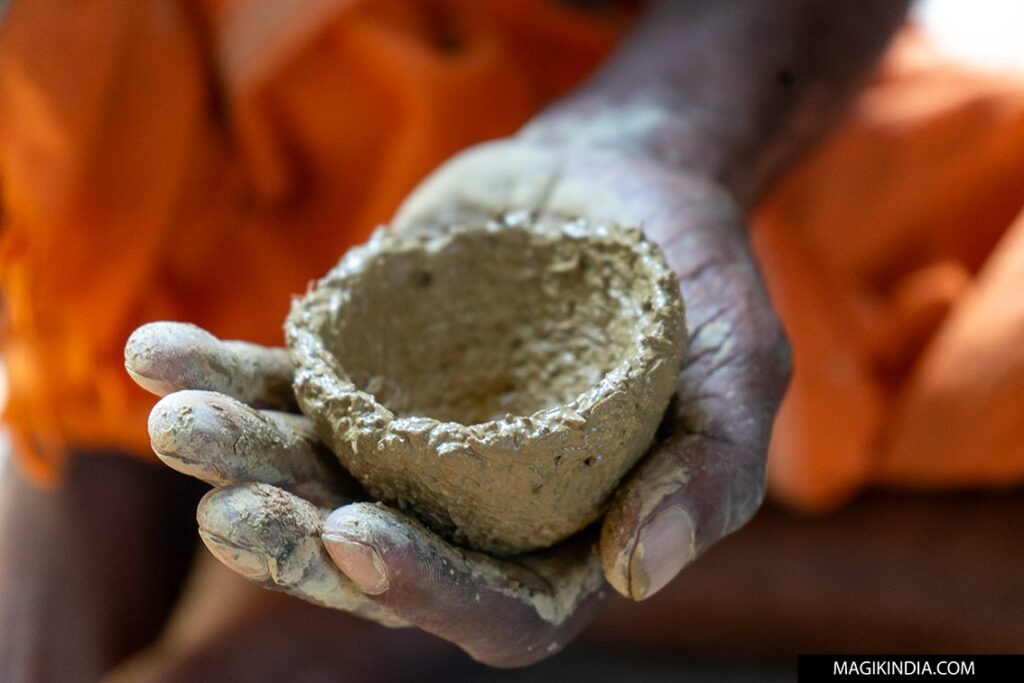
At the end of the mould, the artisan fashions a sort of clay cup or reservoir, directly connected to the object by a pouring gate that serves as a bridge between the metal reservoir and the sculpture. Pieces of scrap brass and bronze, such as old utensils and metal debris, are placed inside this reservoir.

This is one of the most ingenious technical features of Dhokra: unlike traditional casting, where metal is poured into an open mould, Dhokra often employs a closed system.

After depositing the metal into the reservoir, the craftsman seals it to the pouring mouth with clay. The assembly then becomes a monolithic, airtight block, uniting the wax-filled mold with the crucible containing the cold metal.
The “Lost-Wax” Method
Once the mould is hermetically sealed, it enters the most perilous phase of the process: firing and gravity casting. It is at this moment that fire transforms the clay into ceramic and the solid metal into an incandescent liquid.

The moulds are carefully stacked in a traditional kiln, often a pit dug directly into the ground or a brick structure, then covered with charcoal and wood.

Under the influence of heat, the wax occupying the space between the core and the casing melts. It is absorbed by the porous walls of the mould (hence the name “lost wax”). This departure leaves a millimetre-thin void, a “negative impression” faithful to the slightest detail of the original threading.

The moment of the pour marks the climax of the process: with a precise gesture, the artisan inverts the incandescent mould to release the molten metal. Driven by gravity, the liquid flows from its reservoir and surges into the void left by the wax, embracing every minute striation of the design.
The Birth of the Object

Once cooled, the artisan breaks away the outer mould with a hammer. Dhokra is instantly recognizable by its rustic appearance and detailed finishes featuring spiral and filigree motifs. Unlike smooth statues, Dhokra reveals the texture of the original wax threads, giving the objects the look of metal lace.

The artisans draw inspiration from their immediate surroundings, crafting animals imbued with powerful symbolism such as richly adorned elephants, proud stags and horses, or totemic turtles. This fauna coexists with a spiritual realm populated by local deities and fertility goddesses, as well as vibrant scenes of daily life: musicians, water carriers, and ancestral hunting scenes. Each piece thus becomes a narrative in metal, capturing the essence of India’s ancient tribal culture.
MEET THE DHOKRA ARTISANS OF CHHATTISGARHVous aimerez peut-être aussi...

Phad is one of India's most fascinating artistic and cultural expressions. Originating from the district of Bhilwara and more particularly...
In the hollow of the wooded hills of the Maikal range, in the wild setting of Chhattisgarh, the Bhoramdeo temple...
Lost in the middle of the tumultuous currents of the Brahmaputra, the island of Majuli is a world apart. As...
Located in the Bastar region (Chhattisgarh), the town of Barsoor stretches along the peaceful banks of the Indravati, witnessing its...

If Gujarat captivates me, it is above all by the human richness of its communities. After exploring the world of...

