

Situated in the vast expanses of Rajasthan, halfway between Udaipur and the Pink City, Shahpura cultivates the art of discretion....

Galavan, Gavari’s last act
For forty days, the mystical theater Gavari comes to life under the footsteps of troupes of Adivasi artists, who travel through the villages of Mewar (Rajasthan) to embody deities and demons. The last act, called Galavan, reaches a poignant intensity up to the sacred bath of the deity Gorja Mata. This solemn ritual marks the culmination of a month of asceticism and marks the return of the divinity to its original element.
It took many long years for me to finally witness Galavan’s festivities from start to finish. As the location of the celebration shifted over the years, I had to wait until it finally arrived right at my own doorstep. And what a celebration it was! Truly, the best things are always worth the wait!
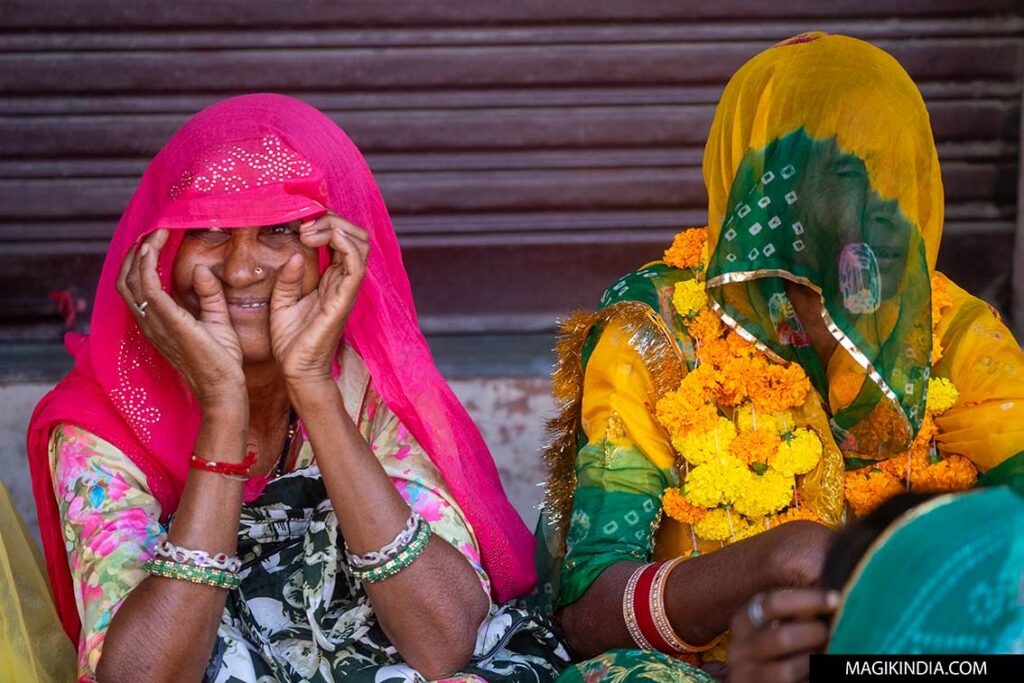
Around 11 a.m., I arrive in the Mala Talai neighborhood of Udaipur, where a large Bhil community has settled. For once, my timing is perfect, neither too early nor too late for the start of the festivities; my tip finally paid off!

I pass by a few houses, whose inhabitants, taken by surprise, greet me with a wave. A pathway draped in festive fabrics leads me to the temple of Beruji—a fierce avatar of Shiva, recognizable by his dog, his divine mount.

Within the temple precincts, the sacred fire is tended in order to collect embers for the dhuni, a vessel placed at the feet of the deity.
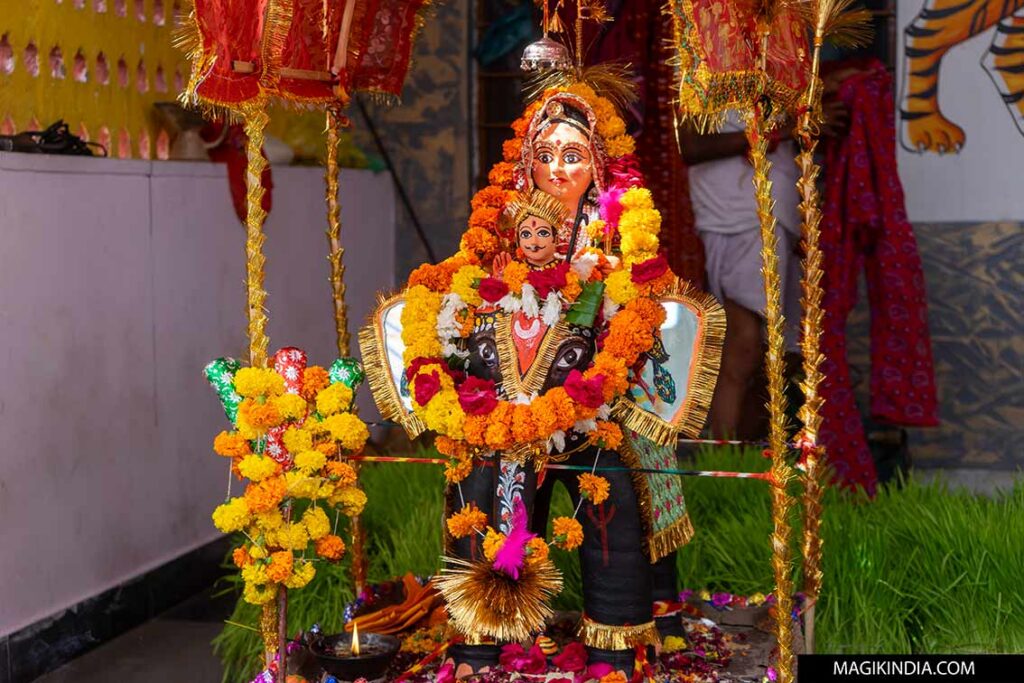
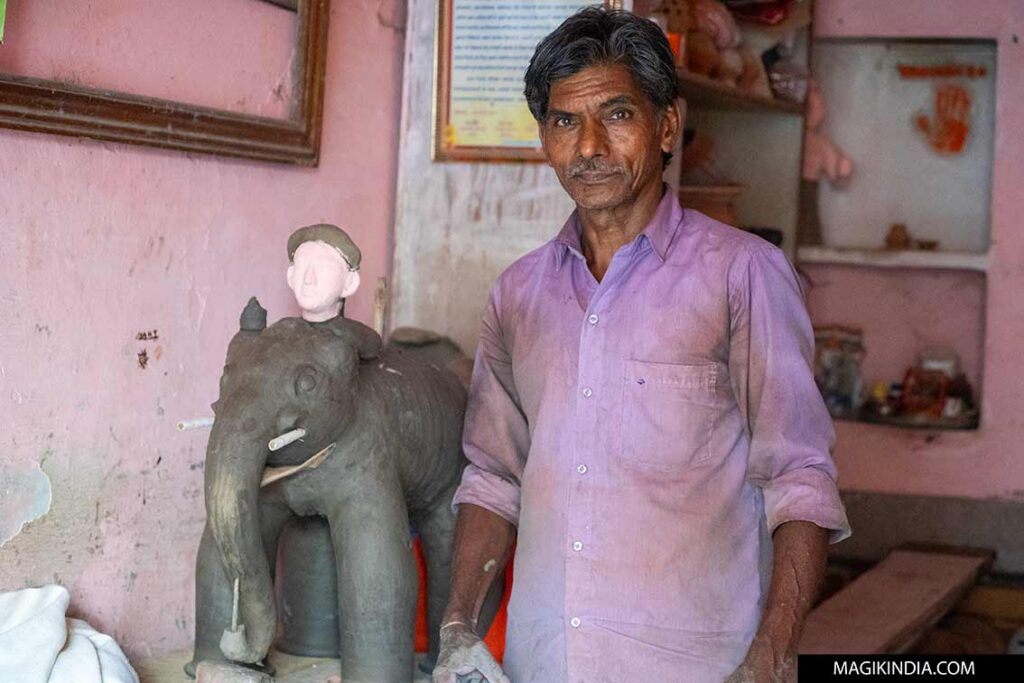
At the very back, sheltered under the temple porch, men cool an idol with a movement of their chavar (fan). As I move forward, I can see the goddess Gorja, perched on her clay mount, an elephant modeled by the kumar (potters) of the region. Local figure of the goddess Parvati and consort of Shiva, Gorja embodies Shakti, the very essence of the universal feminine principle.

At his feet, resting in a basket, lies the mask of the Budiya. Representing the demon Bhasmasur, who was granted forgiveness by Shiva, the Budiya serves as the master of ceremonies for the Gavari. Behind his wooden mask, with its exuberant features, he diffuses fear often through raw, unbridled energy, moving against the flow of the other dancers to underscore his distinct role.

Bhopas (shaman-priests) encourage me to enter the sanctuary where the protective deities of the neighborhood keep watch. They are busy with the final preparations and put on their ritual clothes.

It does not take me long to identify the Rai Mata, draped in red and wearing long veils that frame their faces. As prominent and powerful figures in the Gavari tradition, they embody Parvati and Mohini.

The atmosphere oscillates between relaxation and solemnity, while we can already sense the concentration of the bhopas absorbed in the preparations for the rituals.

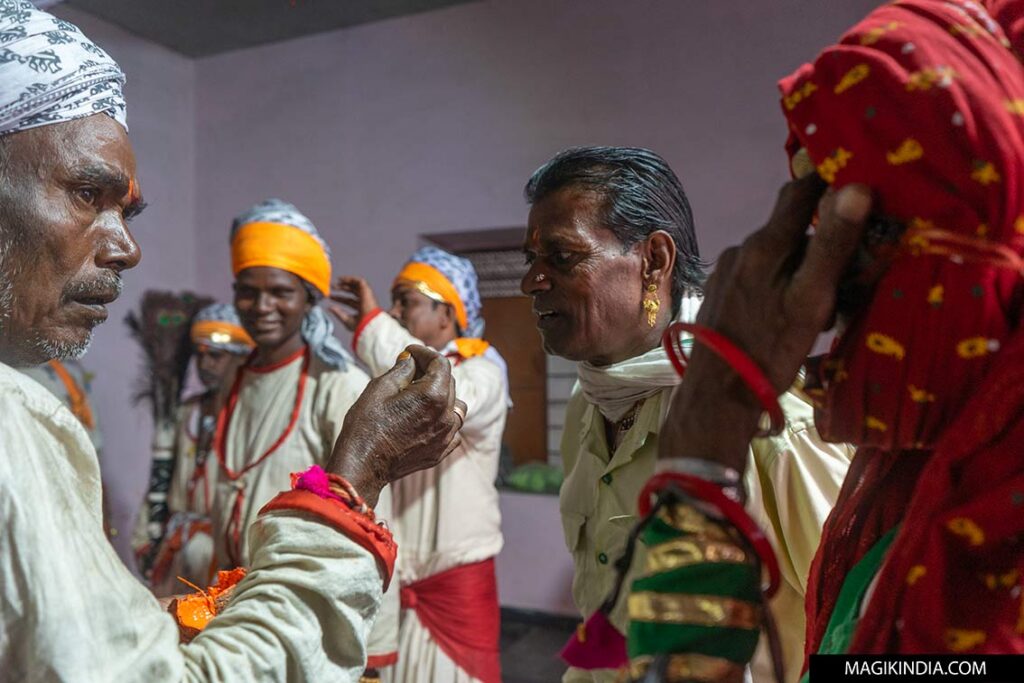
The ceremonies open with a divinatory consultation (Akha): a bhopa grabs grains of wheat and corn, counts them and seeks to obtain specific combinations of even or odd numbers. Depending on the number and order of these grains, it summons good fortune and prosperity, or brings to light the anger of an ancestor or a malicious spirit.

I am now alone among the bhopas, while the crowd waits outside the temple enclosure. I find myself questioning my presence here. Yet, as no one forbids me from staying, I savor the grace of this suspended moment, brought into the closest proximity to the rituals.

The bhopas quickly enter a trance, their breath coming in short gasps as they wave their morchadis (bundles of peacock feathers). With their bodies racked by spasms, some seize chains and strike their own backs. Far from being a form of punishment, this act serves to contain the power of Shakti.
If we still doubt the reality of their trance, we just have to weigh these chains: it takes a modified state of consciousness to endure repeated blows without pain for forty days in a row.

The bhopas and the two Raï mata then head towards the neighborhood square, where they plant the flag of Shakti as well as its symbol, the trident, which marks the center of the rituals.

They will then sit in a circle for several hours, motionless under the blazing sun. Only the faithful will come to disturb their silence by hanging garlands of flowers around their necks.

Around this sacred circle, the Gavari performance comes to life through a series of unfolding traditional scenes. First, the Budiya appears, moving back and forth before coming to an abrupt halt; he then counts the beads of a mala (rosary) held above his head, signaling the transition from the profane world to the sacred realm.

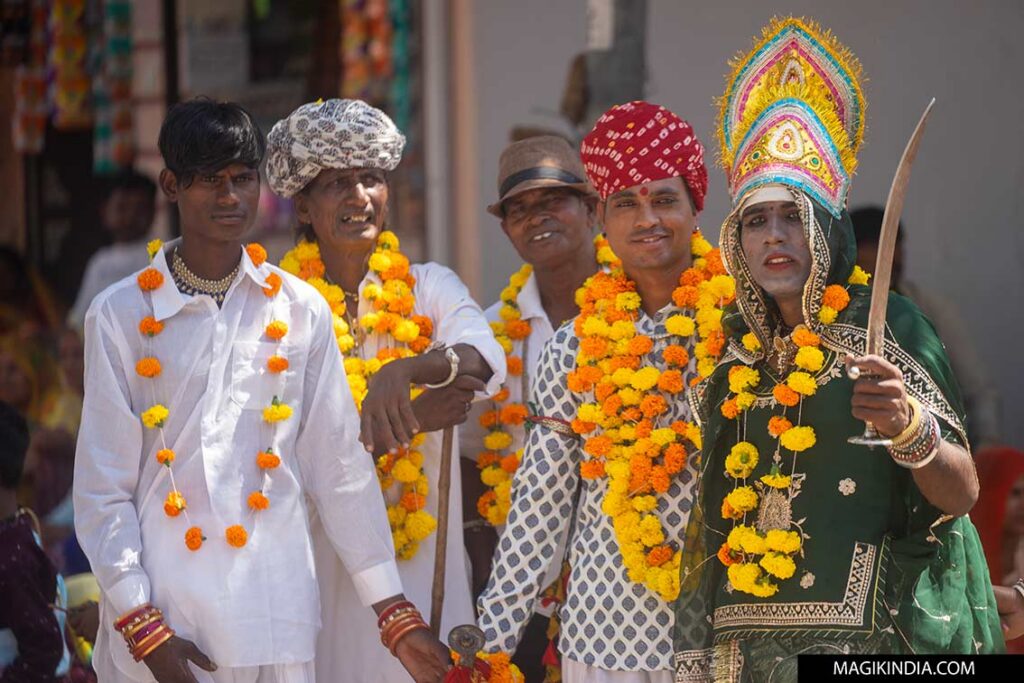
As the circle rituals draw to a close in the mid-afternoon, the moment Galavan has been eagerly awaiting arrives: the grand procession of the goddess Gorja to the shores of Lake Fateh Sagar.

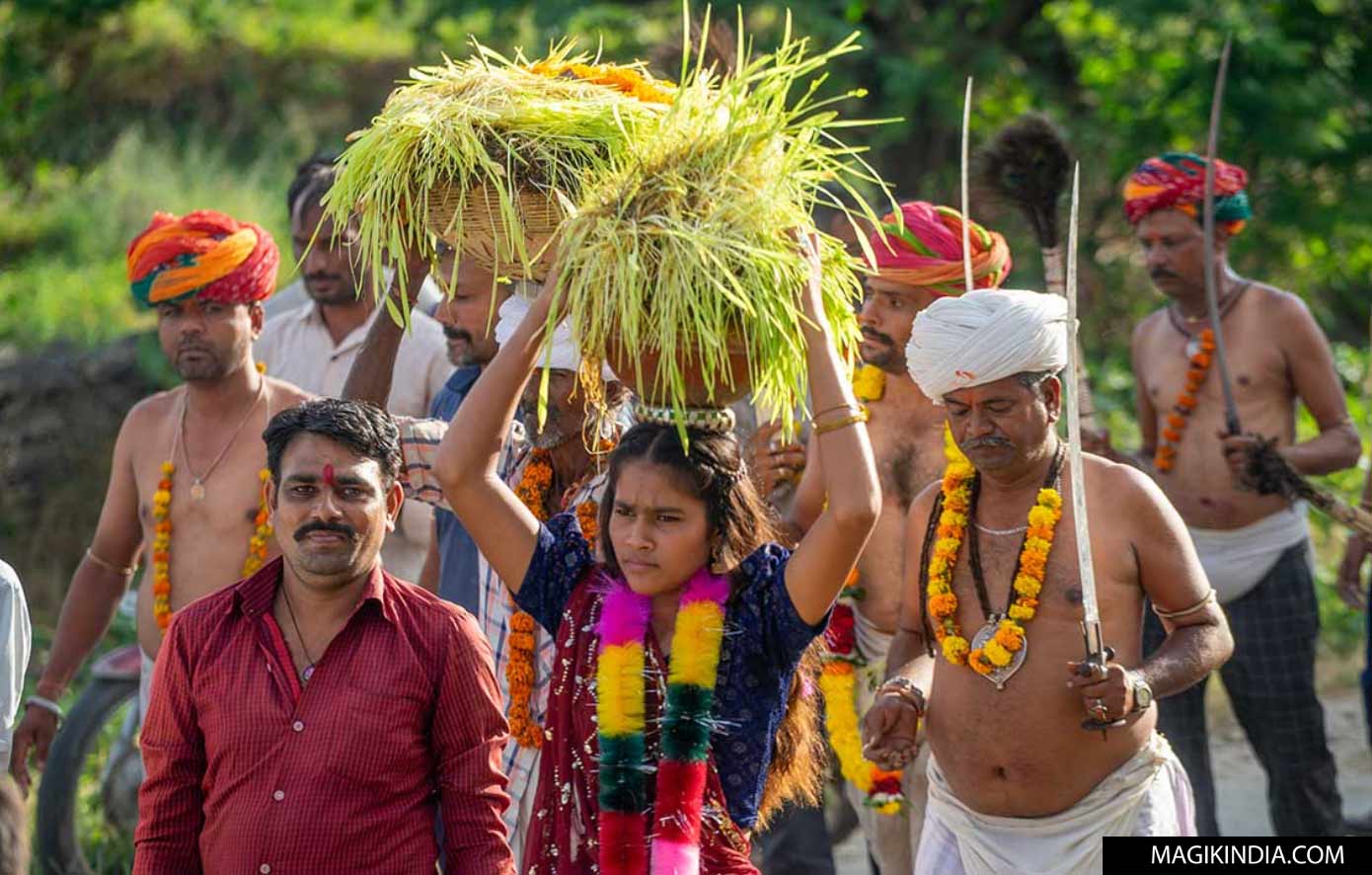
At the head of the procession come the bearers of baskets of sprouted wheat. New to me, some of these baskets are attached directly to the blade of a saber, strikingly reminiscent of the warrior paraphernalia of the goddess.
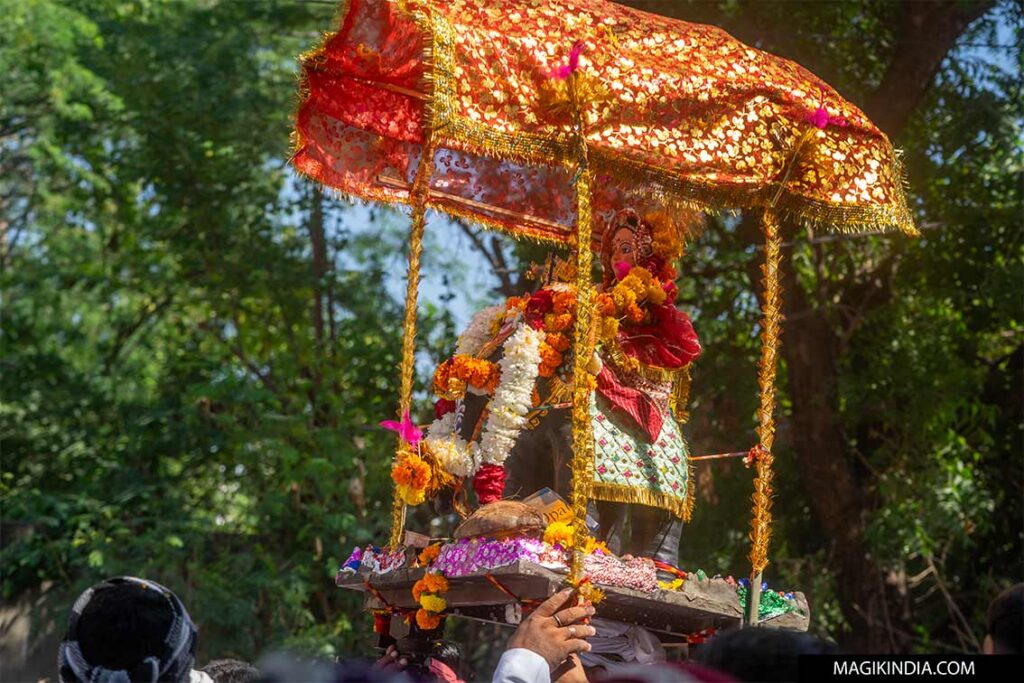
At the end of a walk of several kilometers, the sprouted wheat and the idol of the goddess vanish into the waters of the lake, whispering to our hearts the eternal lesson of impermanence.
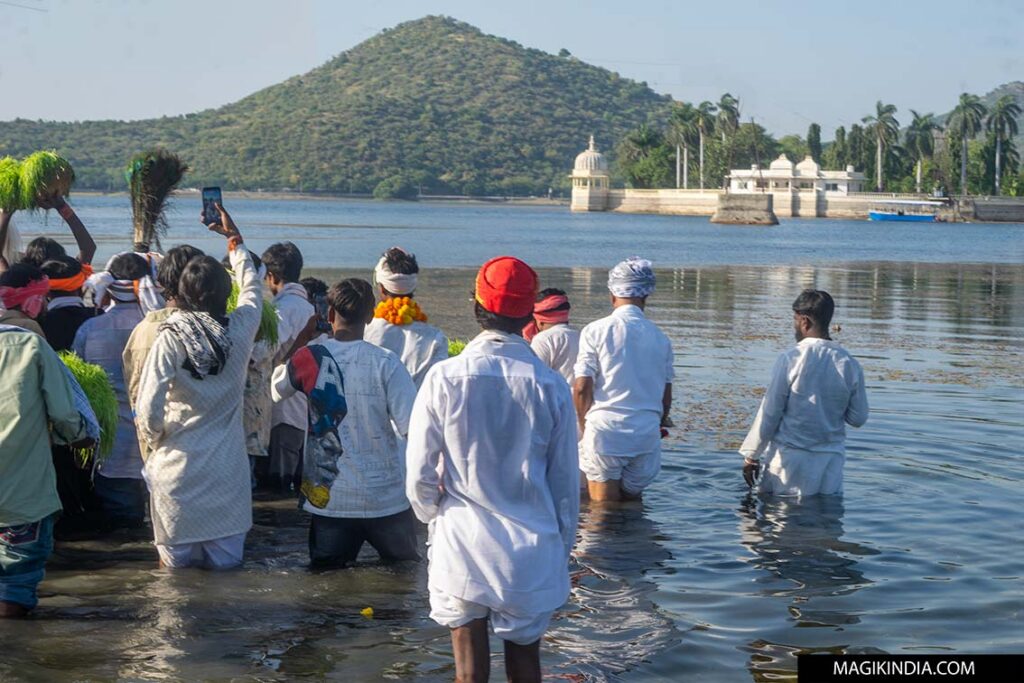
As soon as the immersion is over, the crowd of faithful disperses in an instant, leaving me stunned, as if this whole day at Galavan had been nothing but a sweet dream. For the actors of Gavari, it is the completion of forty days of asceticism and the time to return to everyday life.
KNOW MORE ABOUT GAVARI
Vous aimerez peut-être aussi...
Dussehra, which translates to "the tenth day," is a Hindu festival celebrated with great fervour throughout India. It symbolises the...

Nestled at the foot of the Aravalli Mountains in the peaceful Pali district, the village of Ghanerao is an invitation...

Garba is a sacred folk dance originating from Gujarat, traditionally celebrated during the festival of Navaratri. Performed in a circle,...

Three hours away from Ahmedabad, the Tarnetar fair comes alive as one of Gujarat's most dazzling rural spectacles. Fusing ancient...
In the hollow of the wooded hills of the Maikal range, in the wild setting of Chhattisgarh, the Bhoramdeo temple...

