

If Gujarat captivates me, it is above all by the human richness of its communities. After exploring the world of...
Champaner & Pavagadh, The Two Faces of the Sacred
Between stone-etched memory and living fervor, Champaner & Pavagadh reveals a fascinating dual nature amidst lush surroundings. In the lower valley lie the slumbering vestiges of Gujarat’s 15th-century royal capital, much of which remains mysteriously buried. This historical tranquility is counterbalanced by the sacred vibrancy of Pavagadh Hill, a true spiritual beacon of the region. It is here that the heart of local devotion beats, where thousands of devotees gather to pay homage to Kali Mata within her temple revered as one of the precious Shakti Peethas of the Hindu sacred landscape.
From Ancient Origins to the First Rajput Forts
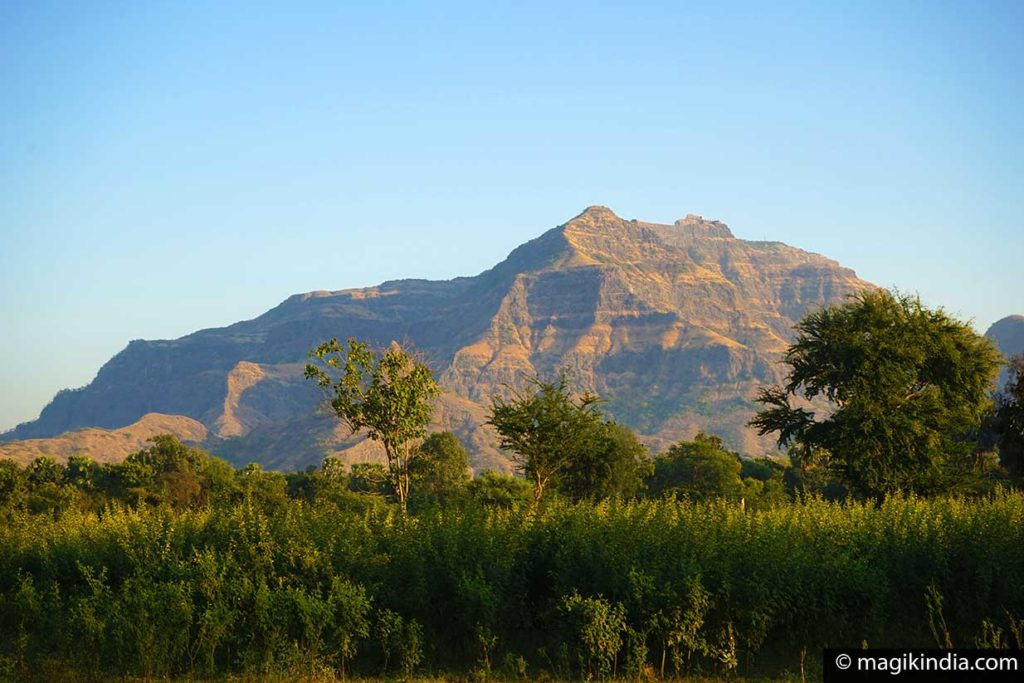
Chalcolithic remains bear witness to a very ancient occupation, although the site appears to have been abandoned around 400 AD. The area was revitalised in the 13th century under the impetus of the Khichi Chauhan Rajput clan. These kings constructed the first fortifications and temples on the upper plateau of Pavagadh Hill, laying the defensive and spiritual foundations of the site.
Champaner under the Gujarat Sultanate (1484–1536)
In 1484, Sultan Mahmud Begada seized the stronghold. He ushered in the city’s golden age by relocating his capital there. A royal city subsequently rose from the ground at the foot of the hill, characterised by refined and monumental Islamic architecture. Champaner embodied the splendour of Gujarat until 1536, when its capture by the Mughal Emperor Humayun led to the definitive transfer of power to Ahmedabad.
An archaeological gem frozen in time
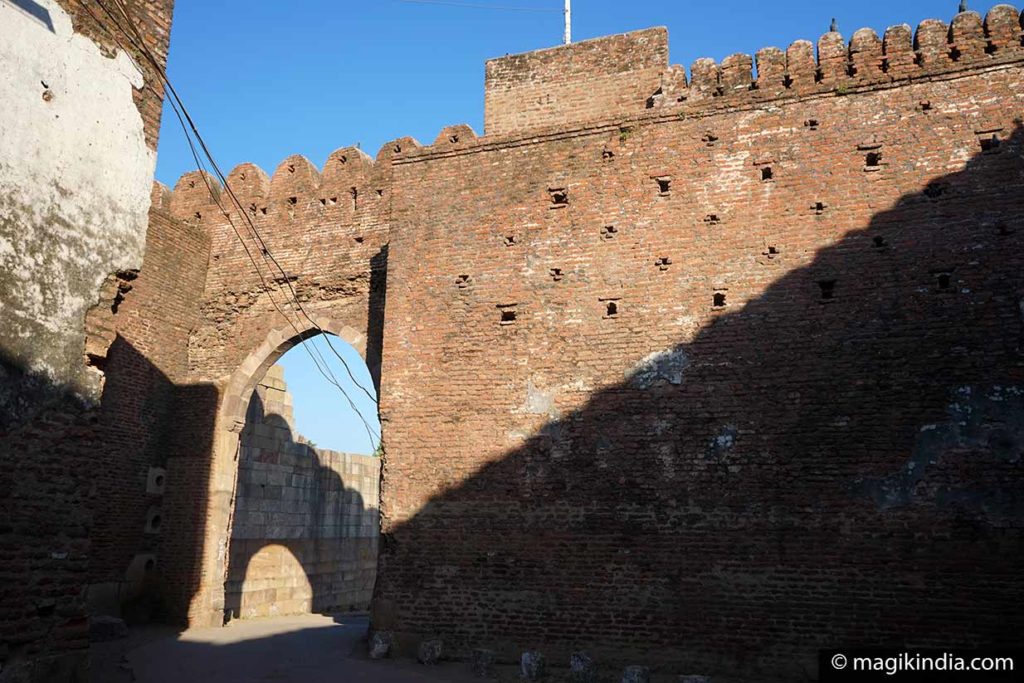
Deserted following the departure of the Mughal court, the city remains frozen in history. This belated abandonment makes it, today, a unique case study: the only complete pre-Mughal Islamic city still surviving in India.
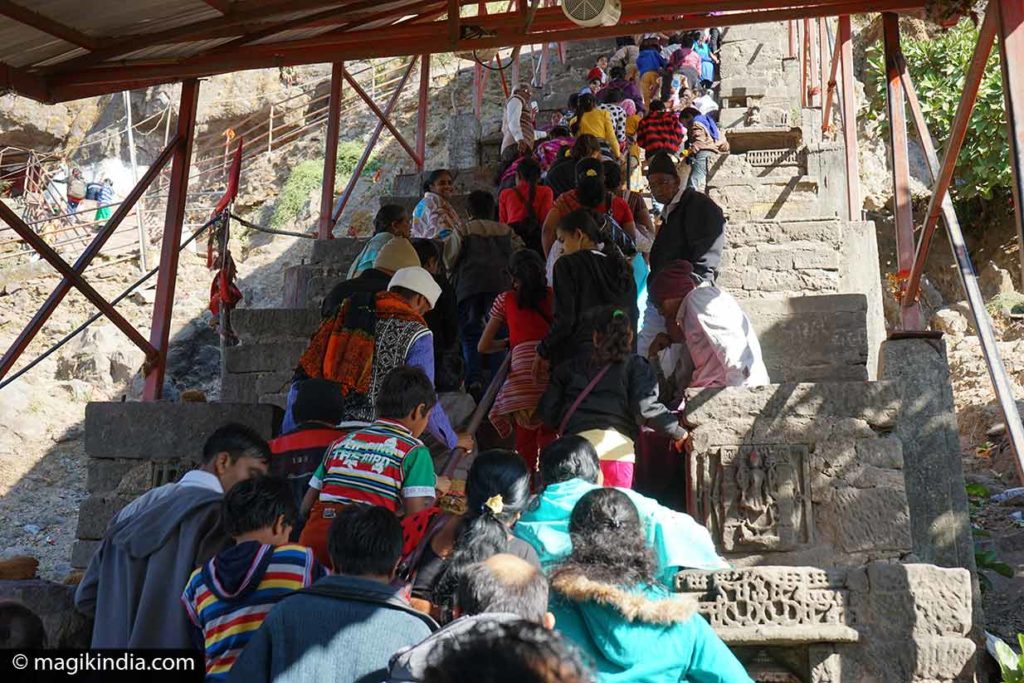
The Enduring Nature of Pilgrimage
Today, it is the importance of the site’s religious character that keeps it alive. The place attracts thousands of pilgrims during festivals dedicated to the goddess Durga.
The Monuments of Champaner
Jama Masjid
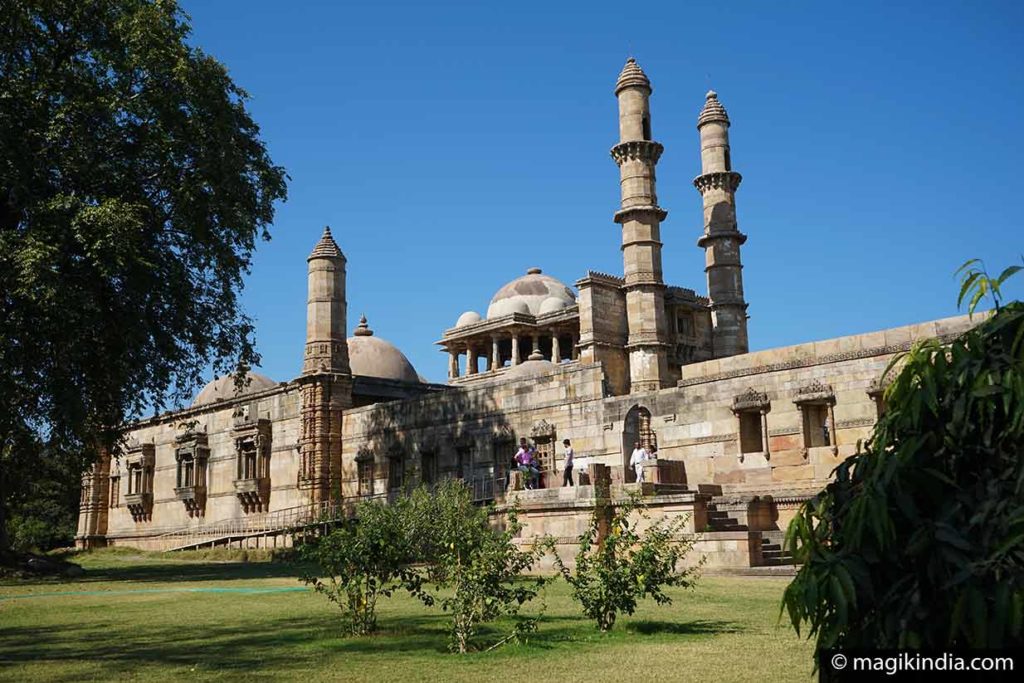
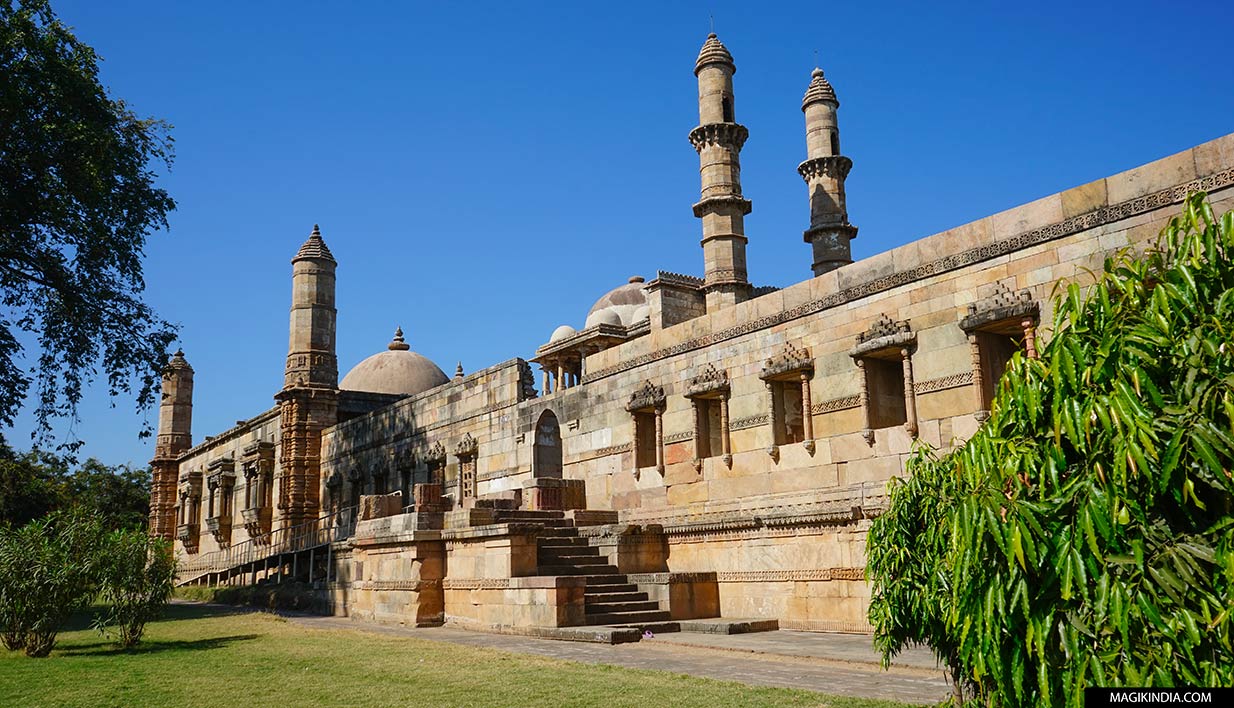
A jewel of the archaeological park, the Jama Masjid of Champaner (late 16th century) embodies the quintessence of Indo-Islamic architecture in Gujarat. The façade of its prayer hall is distinguished by two imposing and meticulously decorated minarets.
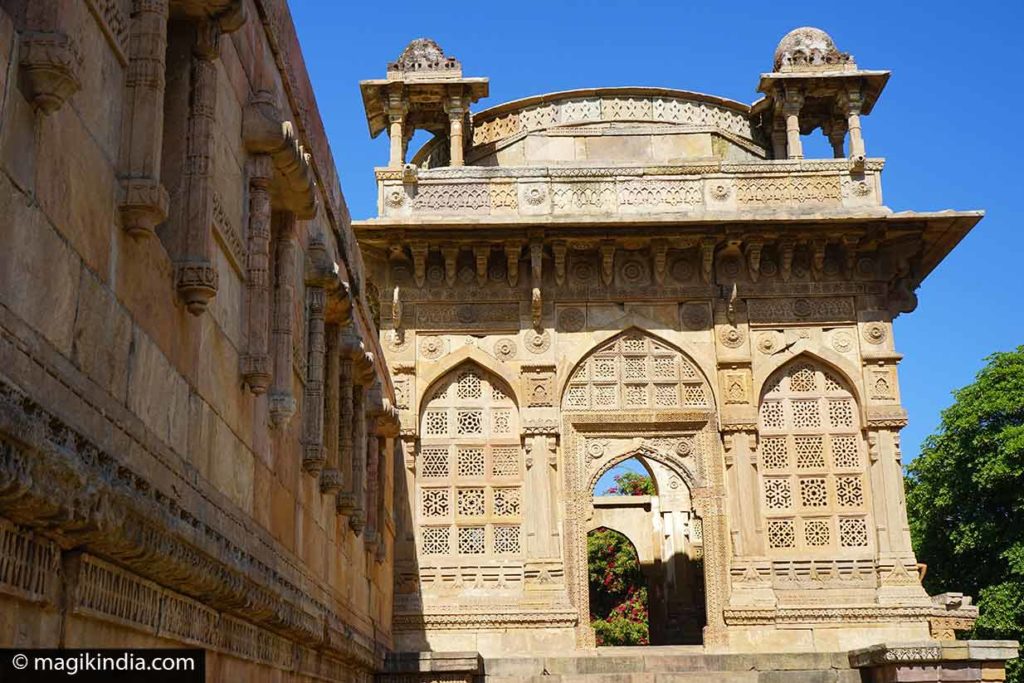
Inside, the qibla wall reveals seven mihrabs carved with surgical precision. Access to the large paved courtyard is gained through three porches, among which the eastern one stands out for the beauty of its jalis (pierced panels), a veritable stone lace that bears witness to the genius of local artisans.
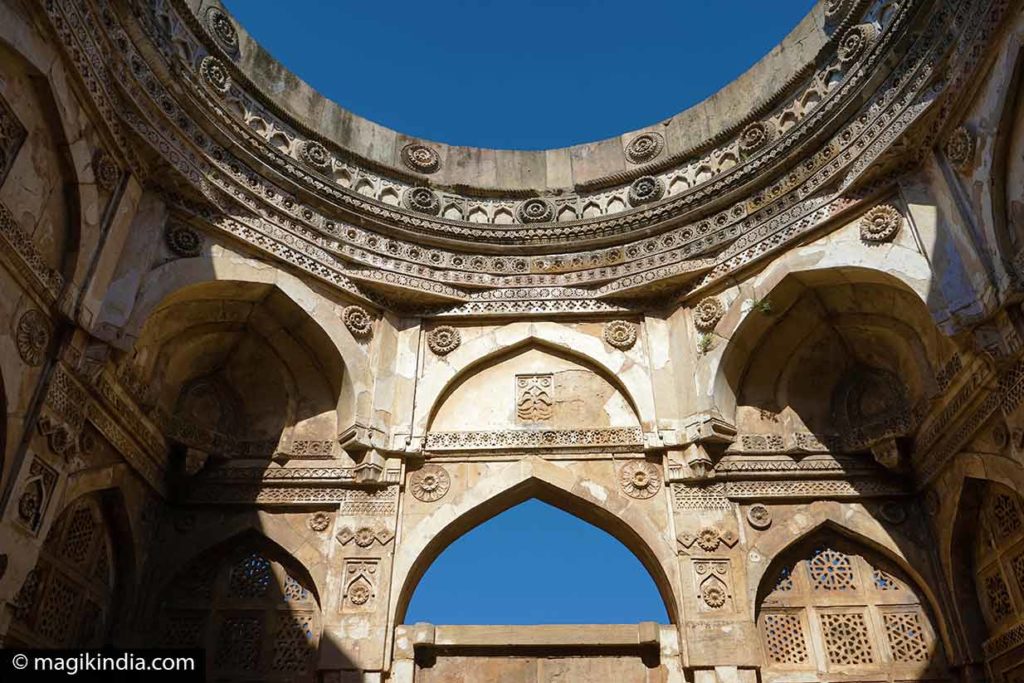
Saher ki Masjid
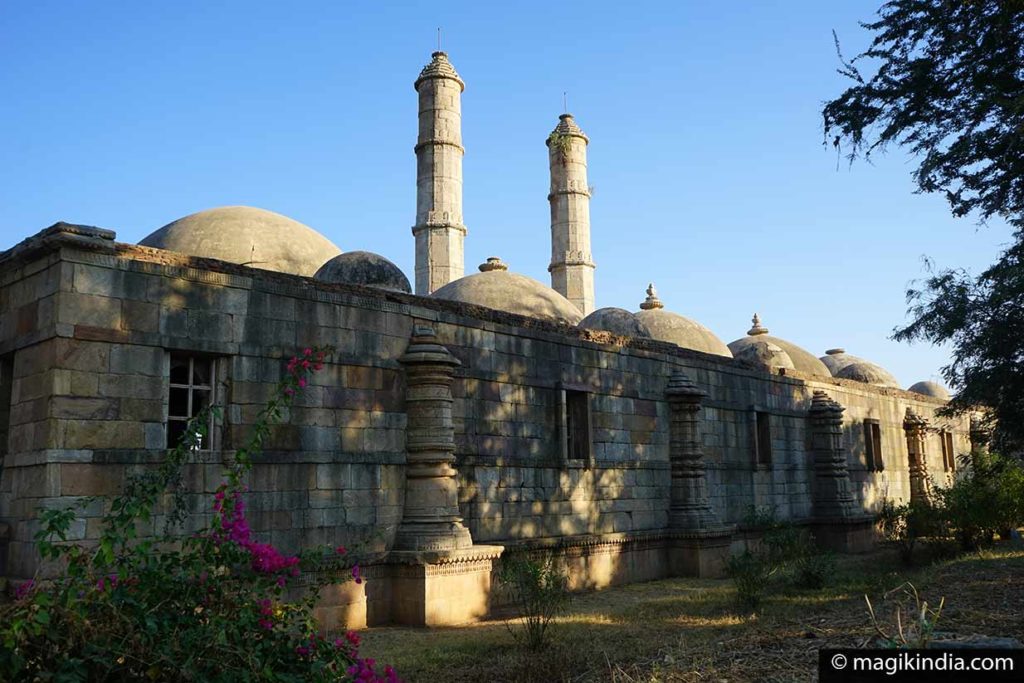
Tucked away in the shadow of the citadel, the Sahar ki Masjid exudes a singular, almost intimate, atmosphere. This “temple of the city,” fashioned at the dawn of the 16th century, was not intended for the common people, but rather for the exclusive circle of Gujarat’s sovereigns and nobles. The pure lines of its domes and its sculpted colonnades tell a story of artistic fusion, wherein the Indian architectural tradition lends its forms and delicacy to the geometric imperatives of Islam.
Kevada Masjid
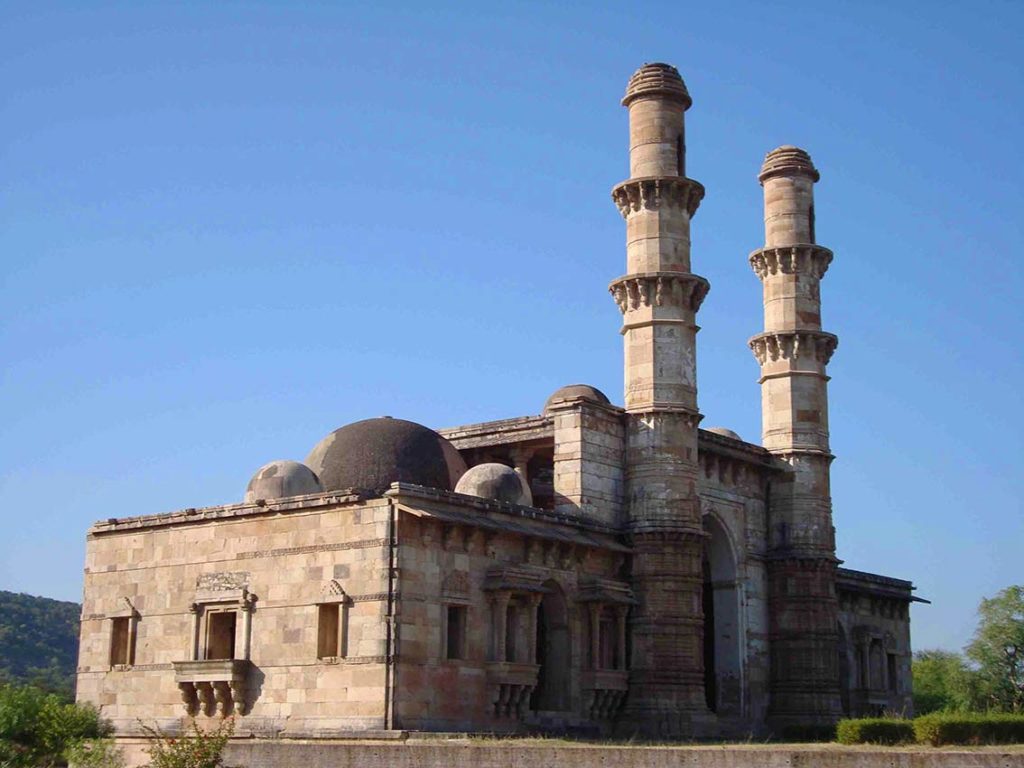
Situated a short distance behind the grand Jama Masjid, the Kevda Masjid was also erected during the reign of Sultan Mahmud Begada. While it shares the Indo-Islamic style characteristic of the other shrines in Champaner, it distinguishes itself in a unique manner through the presence of a square-shaped mausoleum directly adjoining it. This complex, which harmoniously blends the prayer space with the funerary monument also catches the eye with its minarets, richly adorned with floral and geometric motifs.
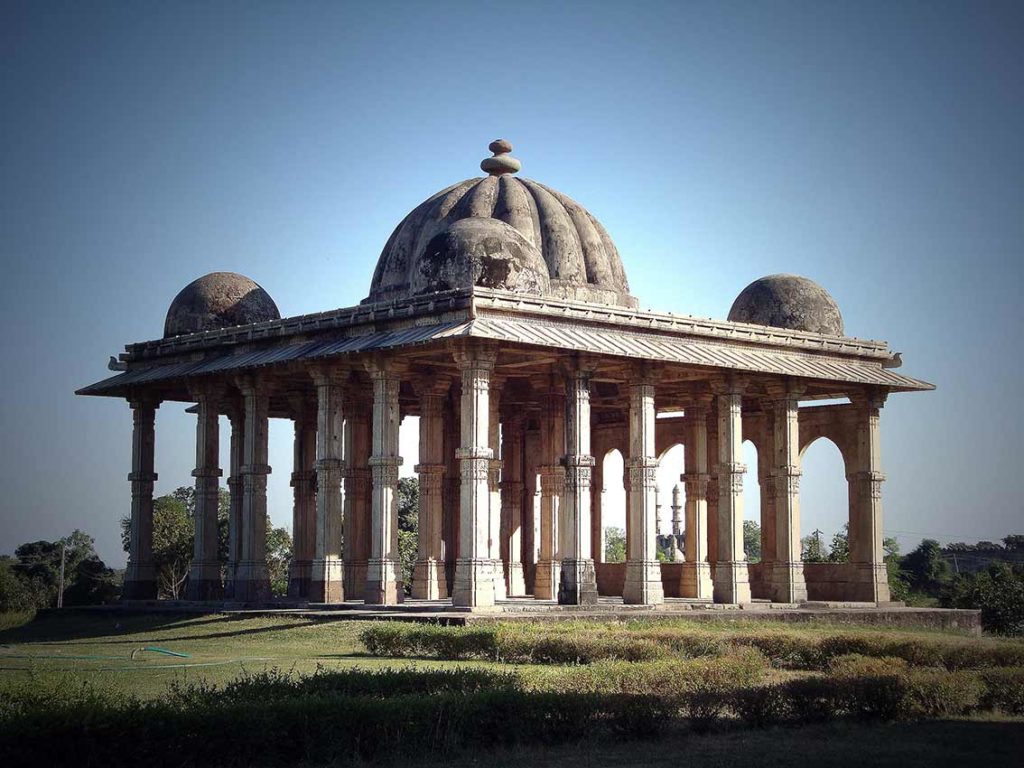
Kabutarkhana Pavilion
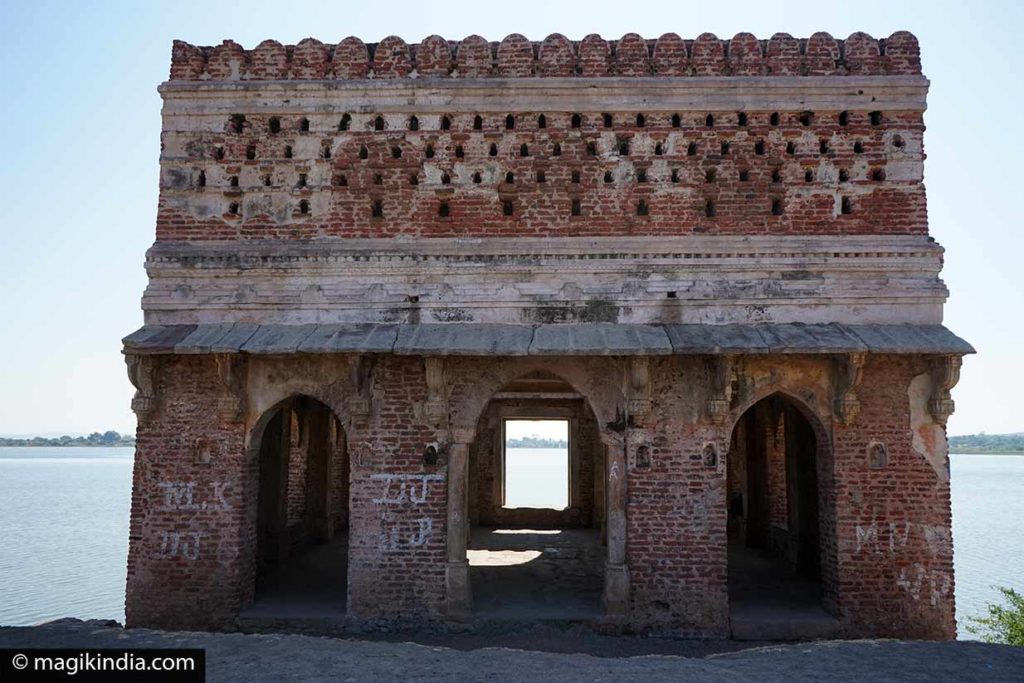
Situated on the banks of Lake Vada Talav, near the Khajuri Masjid, the Kabutarkhana Pavilion enchants with its timeless silhouette. This former royal dovecote, a small brick structure elegantly finished in lime plaster, once served as a sanctuary for the court’s birds.
Today, the site offers a haven of profound serenity: from its arcades, travellers enjoy a spectacular, unobstructed panorama of the sacred hill of Pavagadh, reflected in the peaceful waters of the lake.
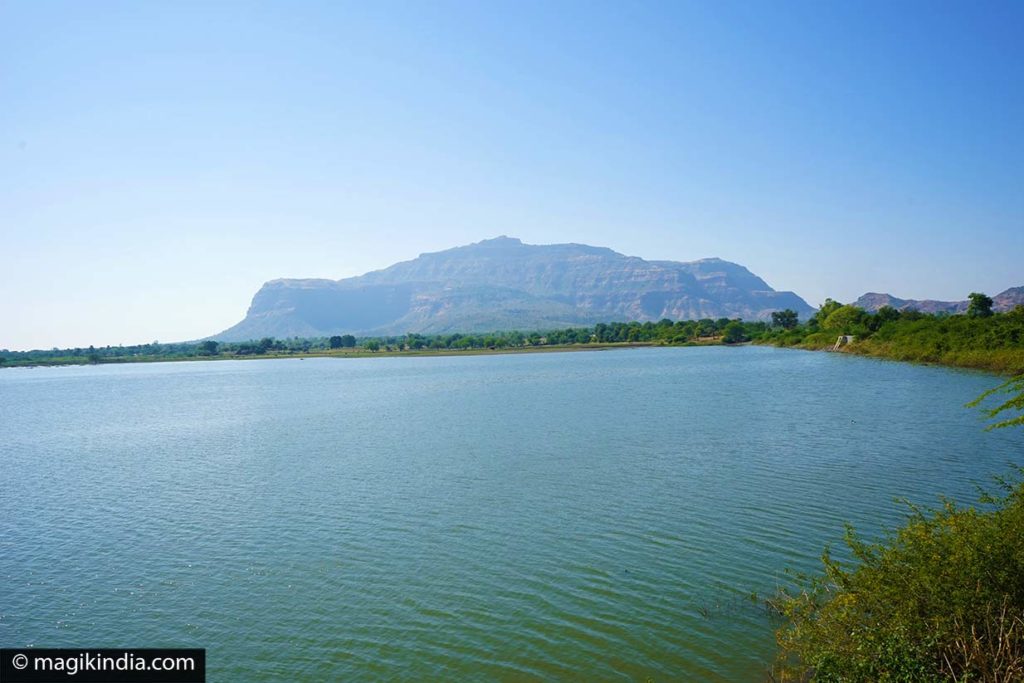
Pavagadh Hill
Long before the arrival of the sultans, the Pavagadh hill was home to a formidable Hindu fortress that enjoyed its heyday under the reign of the Solanki kings and the Chauhan dynasty. Today, access to this historic eyrie is available to you in two ways: the most intrepid travellers may opt for a 5-kilometer hike along age-old trails, while others may prefer to glide toward the summits aboard the cable car, which soars over the sacred gorges in just a few minutes.
Lakulisa temple
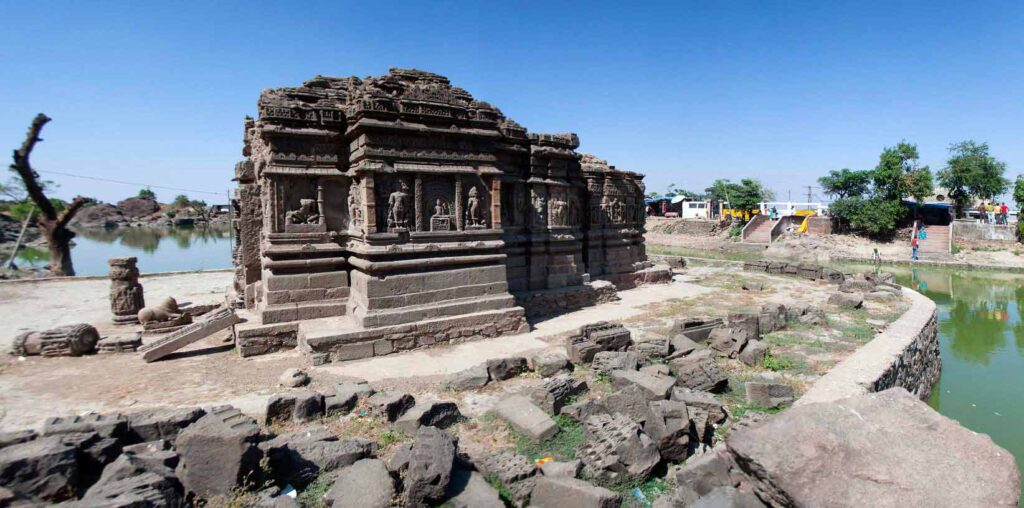
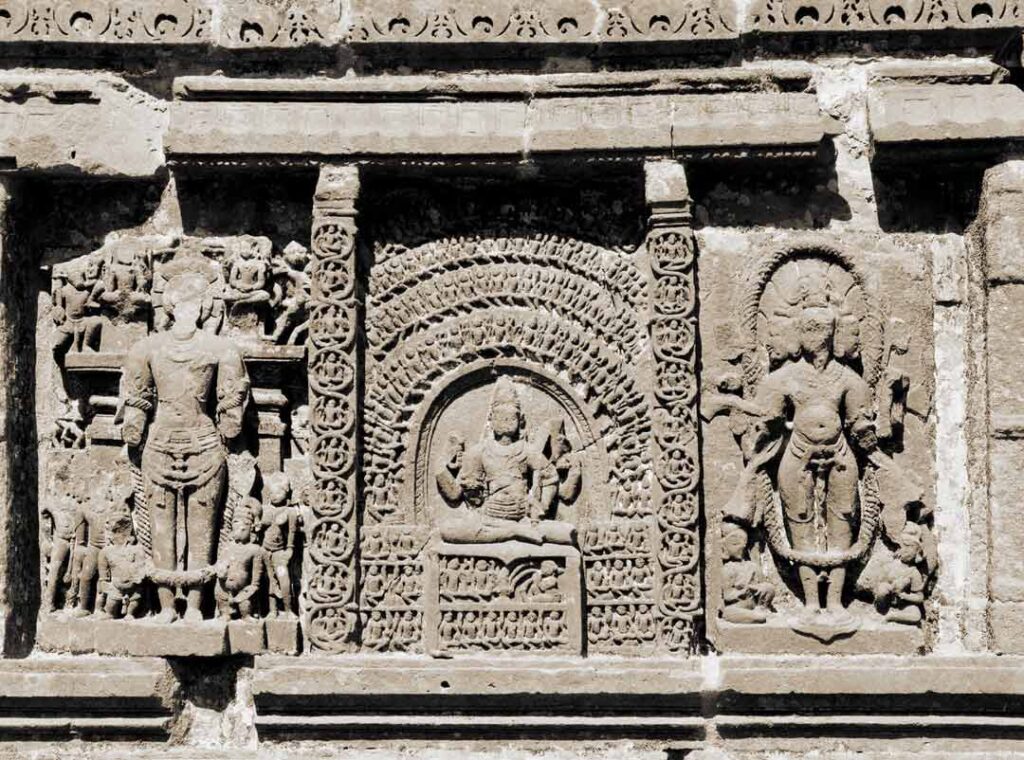
Among the remarkable monuments scattered across the Mauliya plateau, the Lakulisa Temple stands as a fascinating testament to the past. Dating back to the 10th and 11th centuries, this sanctuary is dedicated to a unique manifestation of Shiva, although only a few parts of it remain visible today. Constructed in the Nagara architectural style, the edifice preserves exquisite sculptures depicting various deities from the Hindu pantheon, which defy the passage of time amidst the ritual stones.
Derasars
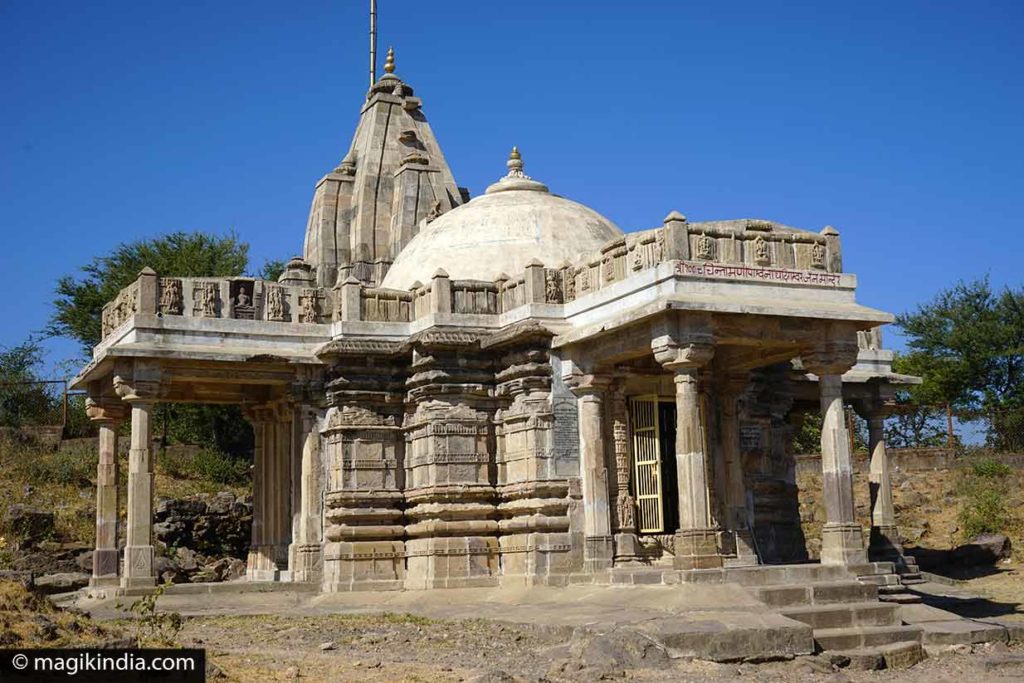
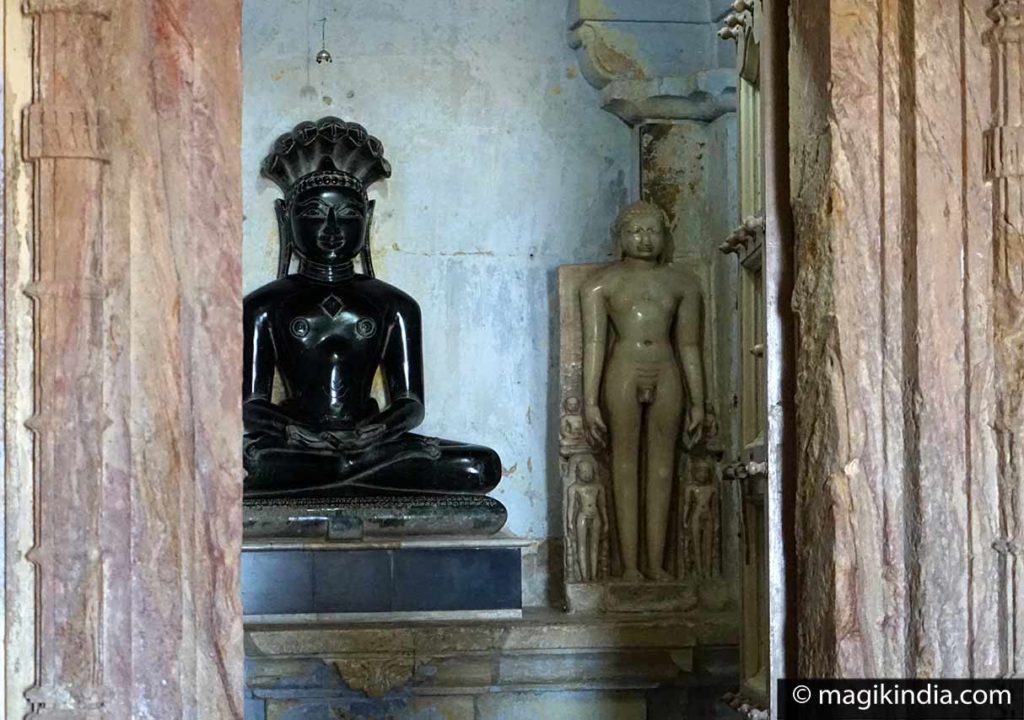
The Mauliya Plateau also houses a major complex of Jain temples, traditionally divided into three distinct groups. The first ensemble, known as the Navalakka Temples, stands proudly near the Naqqarkhana Gate.
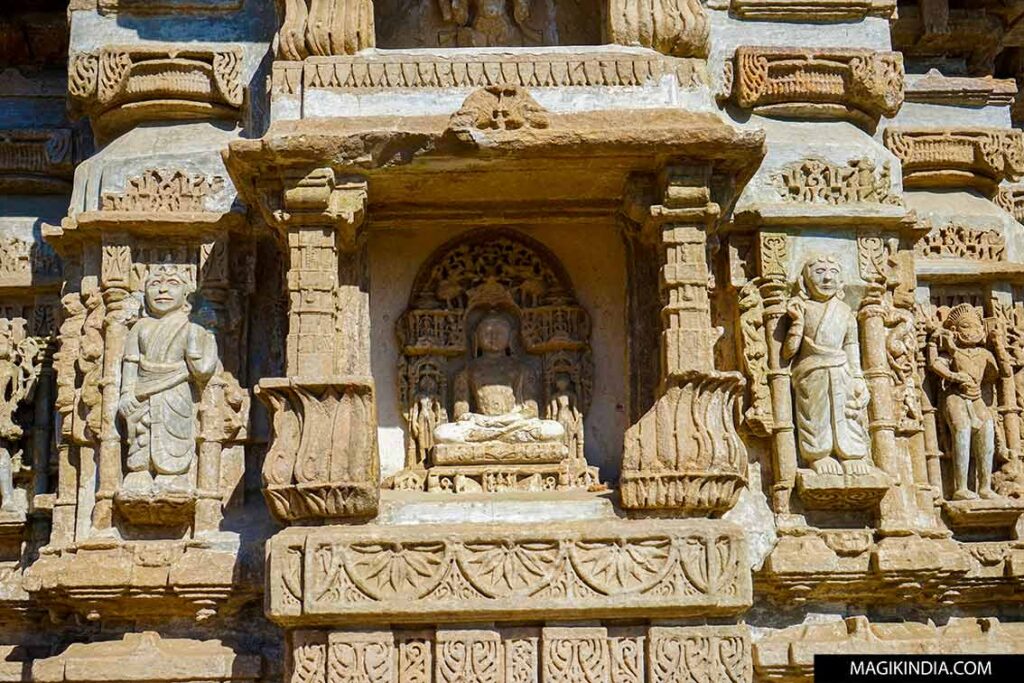
The second group pays homage to the Tirthankaras (the great spiritual masters of Jainism) Suparshvanath and Chandraprabha. Finally, the third group offers a breathtaking view of the sacred waters of Lake Dudhia. According to historians, the construction of these sanctuaries dates back to the 14th and 15th centuries.
Navlakha Kothar
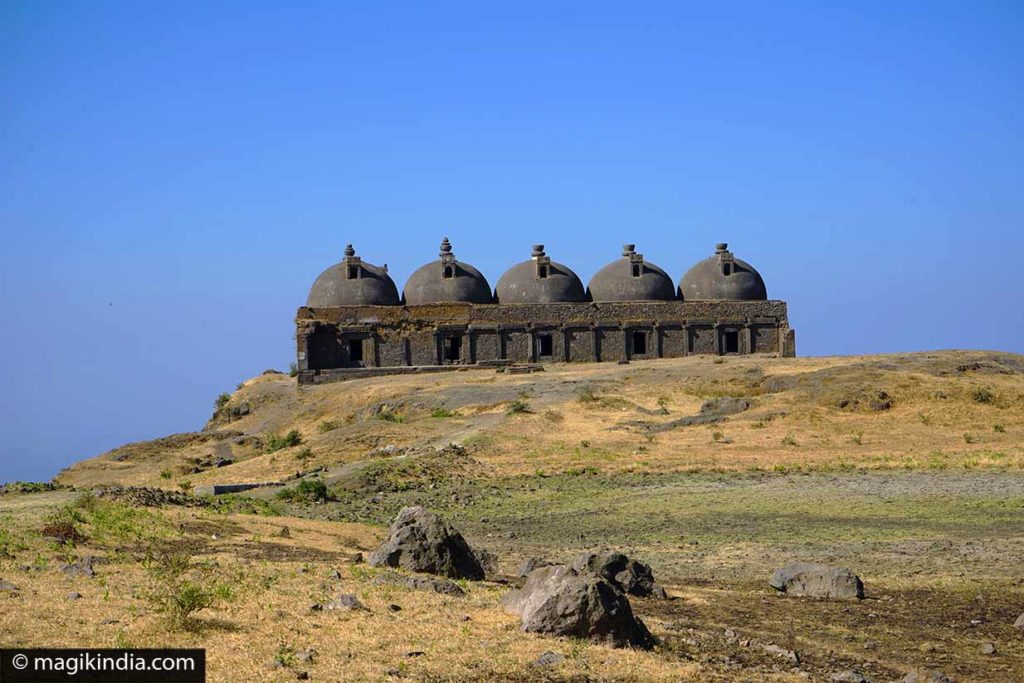
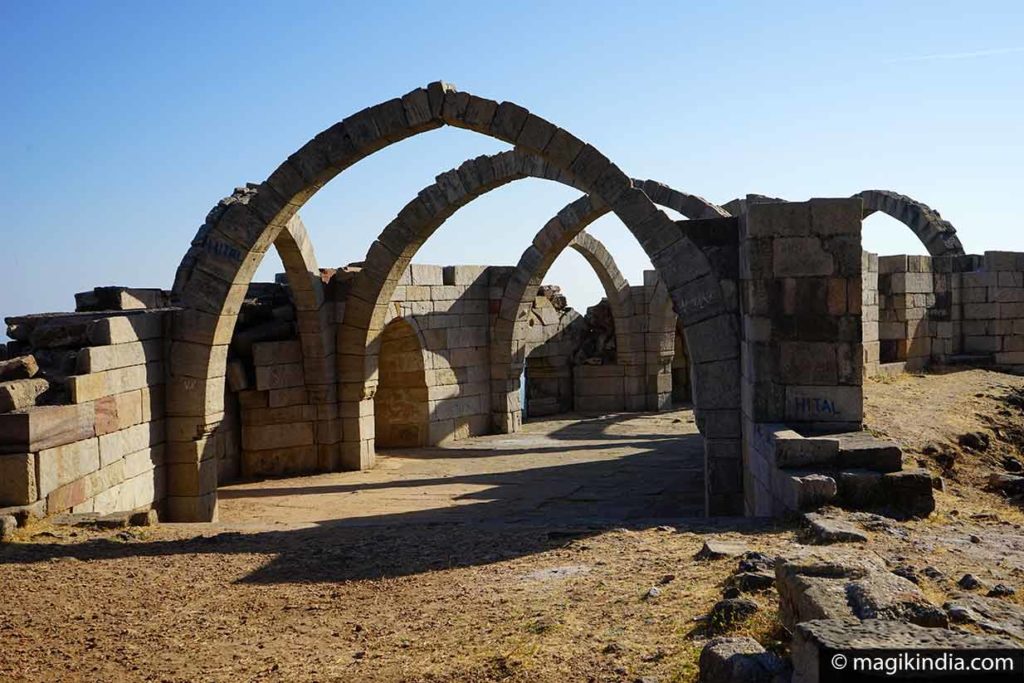
Below the plateau, suspended directly above the dizzying cliffs, stand the spectacular ruins of the Navlakha Kothar. This imposing brick complex, crowned by a series of elegant domes, served as the imperial granary. Its strategic location and massive structures allowed for the storage of sufficient provisions to sustain the citadel’s garrison and population in the event of a prolonged siege.
Kali Mata Temple
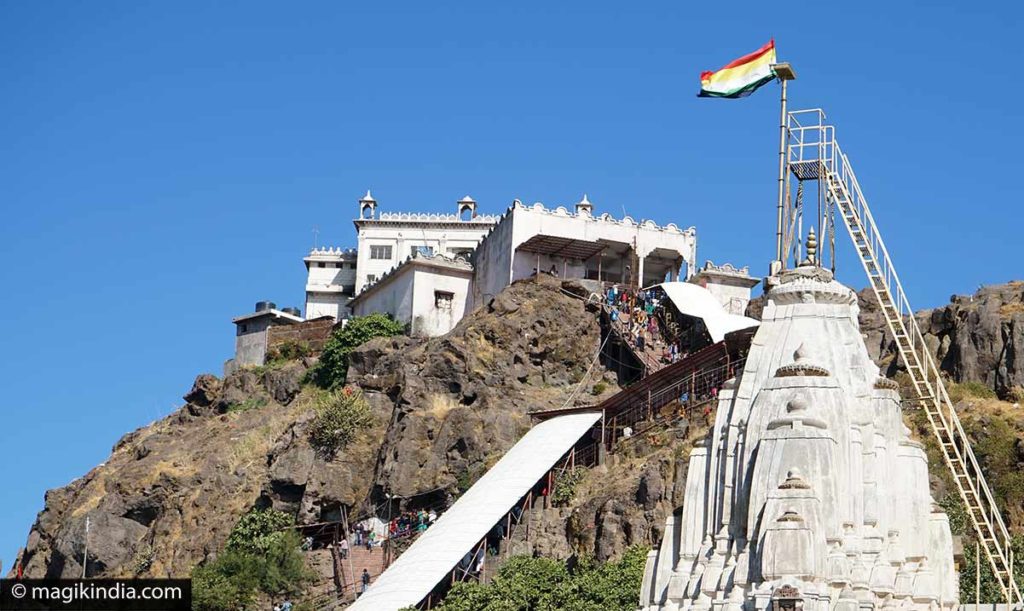
Crowning the volcanic silhouette of Pavagadh at 762 meters above sea level, the temple of the Goddess Kali is the beating heart of the site. Erected at the turn of the 11th century, this historic monument transcends the ages: a major pilgrimage site long before the golden age of Champaner, it remained an unwavering center of devotion even after the city was abandoned.
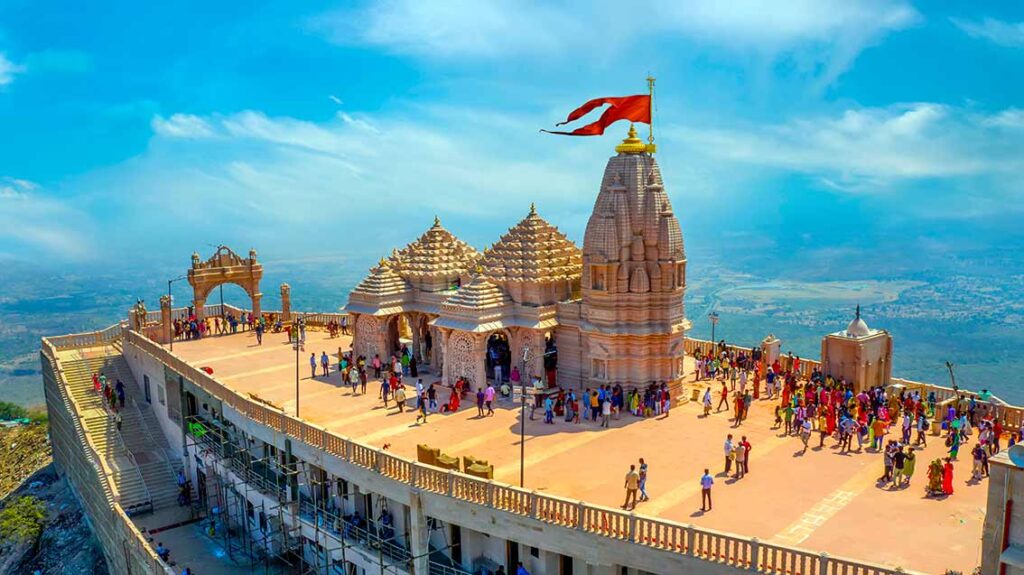
Fully restored and expanded following several years of work, the complex was officially inaugurated on June 18, 2022, by Prime Minister Narendra Modi. This project resolved a historical impasse dating back five hundred years: the amicable relocation of the dargah (Sufi shrine) that crowned the structure finally made possible the reconstruction of the traditional spire (shikhara). For the first time in five centuries, the temple flag once again flies atop the mountain, symbolising the rebirth of this revered site of devotion.
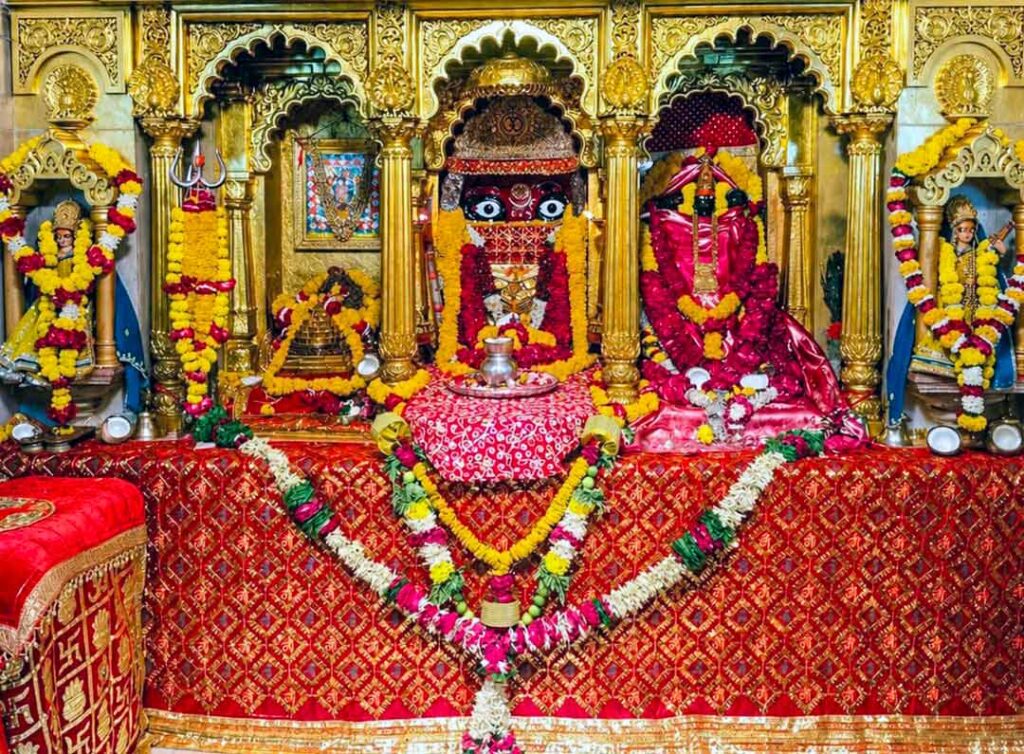
At the heart of the sanctuary, the sacred image of Kalika Mata strikes one with its stark simplicity: it consists of a stylised face with powerful features, painted entirely in a vibrant vermilion red. Flanking it sit representations of the goddess Mahakali, as well as the yantra (a highly sacred mystical diagram) of the goddess Bahuchara.
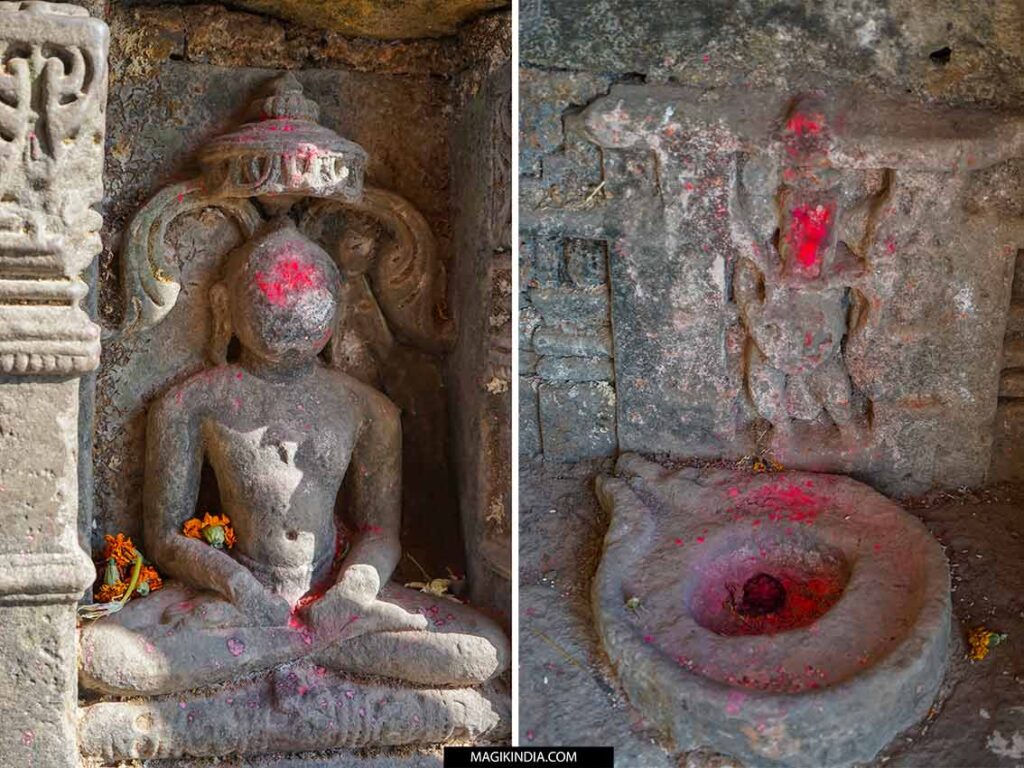
This major pilgrimage site is one of the 51 Shakti Peethas of the Indian subcontinent. According to Hindu mythology, it was precisely upon this peak that the toe of the goddess Sati is said to have fallen, endowing the mountain with divine energy and drawing thousands of devotees in search of blessings every year.
Jambughoda Reserve (26 km)
A short distance from the historical vibrancy of Pavagadh lies the Jambughoda Wildlife Sanctuary. This protected nature reserve, spanning an area of 130 square kilometers, was established in 1990 at the initiative of former Indian Prime Minister Rajiv Gandhi.
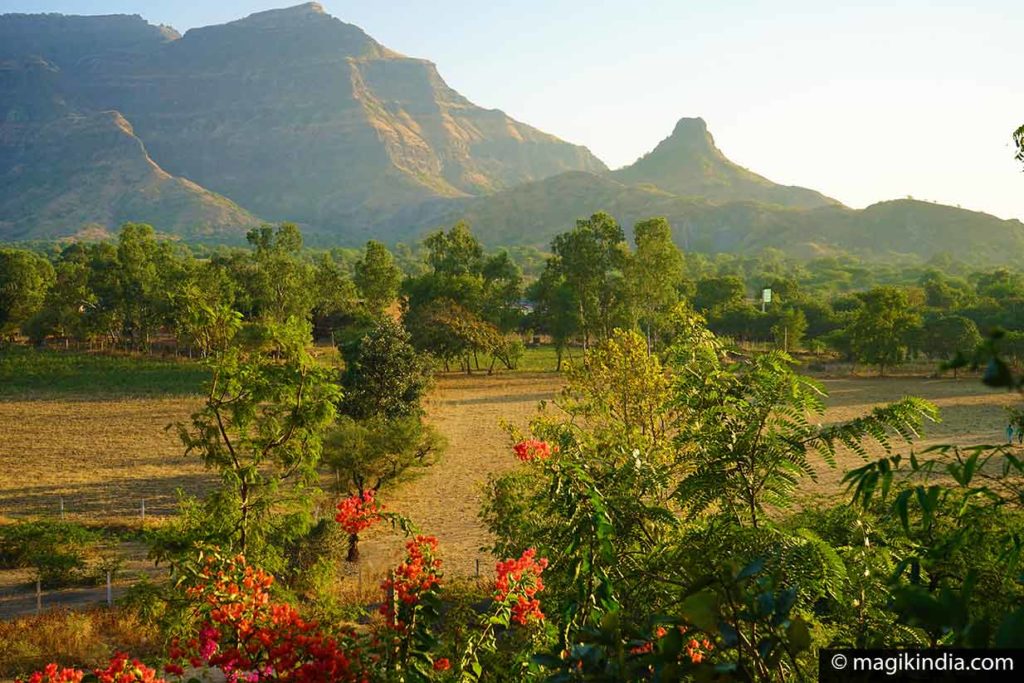
A true green lung of the region, the park is home to a dense forest of teak, bamboo, and mahua trees, serving as a sanctuary for fascinating wildlife. Fortunate travellers may encounter leopards, sloth bears, and antelopes, including the famous nilgai, as well as an impressive variety of birds. It is an ideal stopover for nature lovers seeking serenity after visiting the temples.
Hathni Mata (30 km)
Just 30 km from Champaner, the Hathni Mata Falls offer a perfect refreshing respite. Tucked away in a gorge amidst dense vegetation, this sacred natural site is reached via picturesque country roads.
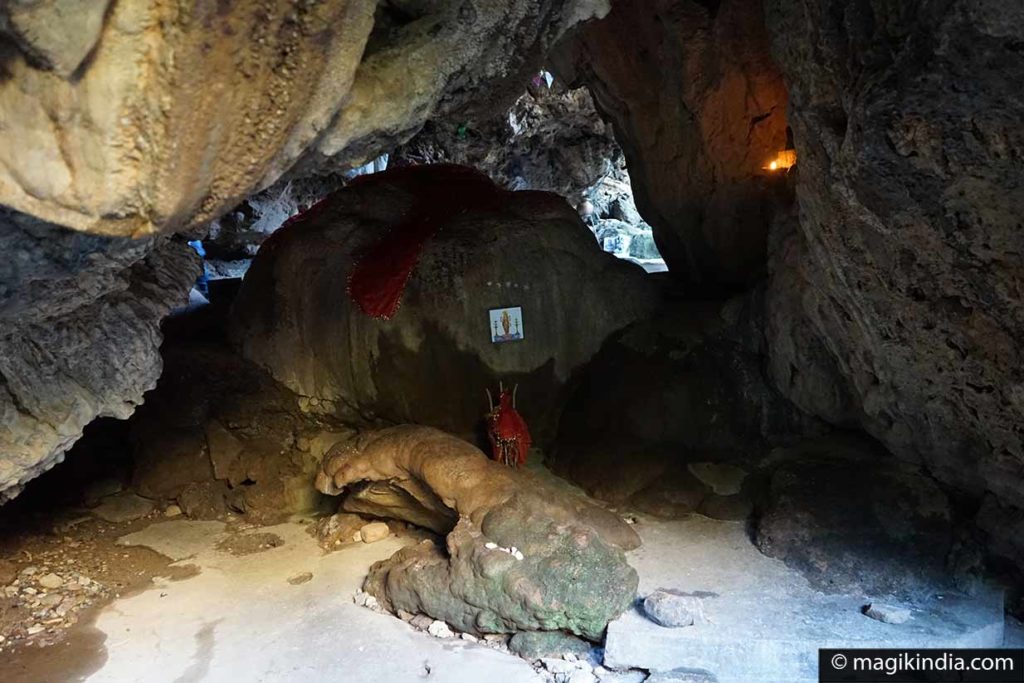
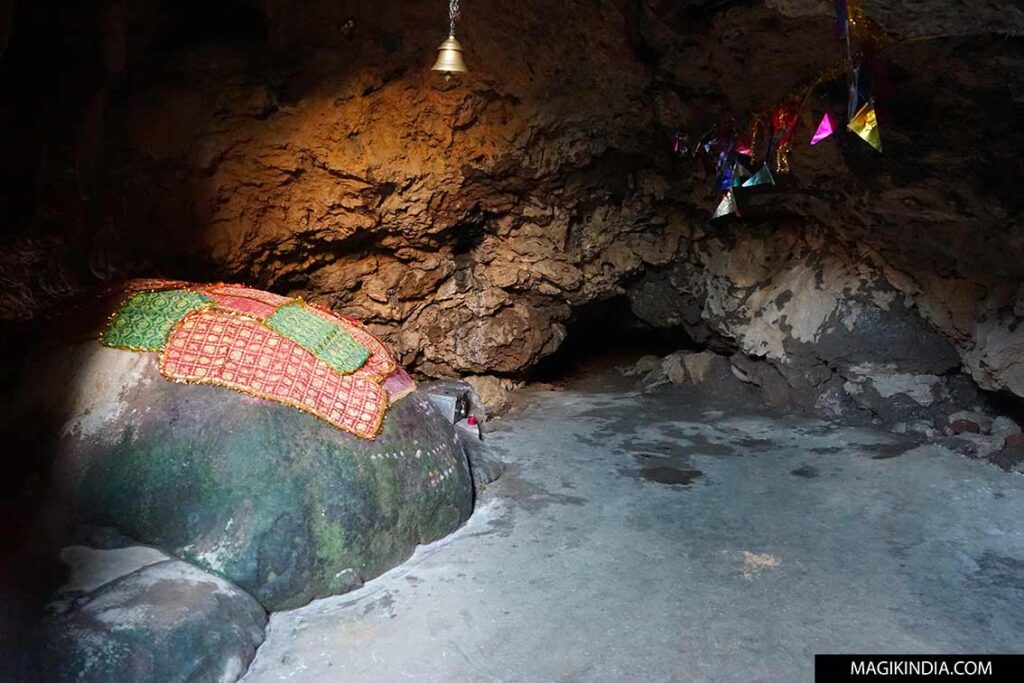
Its name derives from a rock shaped like a seated elephant (Hathni meaning female elephant), housed in a small cave that has become a vibrant place of worship.
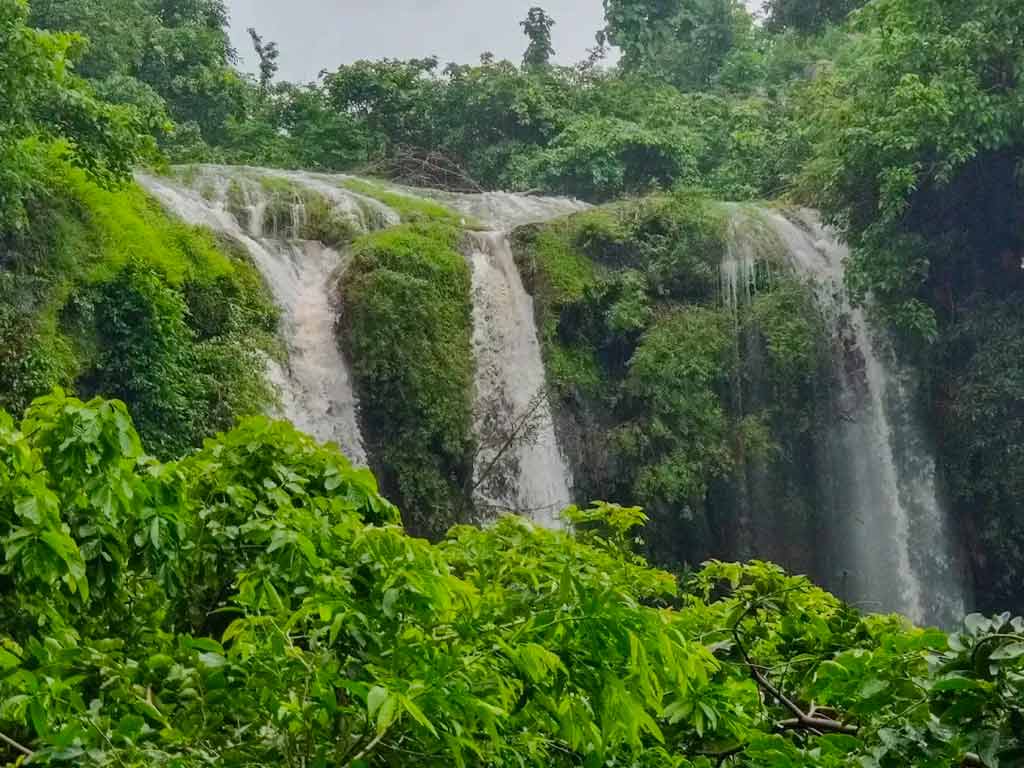
Although the majestic, 100-meter-high waterfalls only come to life during the monsoon season, the site’s impressive geology and peaceful atmosphere make it a rewarding stopover year-round.
Where to stay in Champaner?
Up Close with the Monuments: Champaner, Machhi, and Halol
Ideal if you want to start your sightseeing at dawn or attend the morning pilgrimage.
- At Champaner and Pavagadh : whether at the foot of the site or on the intermediate plateau of Machhi, accommodations remain very simple. You will primarily find Dharamshalas (guesthouses for pilgrims) and small, basic local hotels. This is perfect for an authentic immersive experience, though the comfort is rustic.
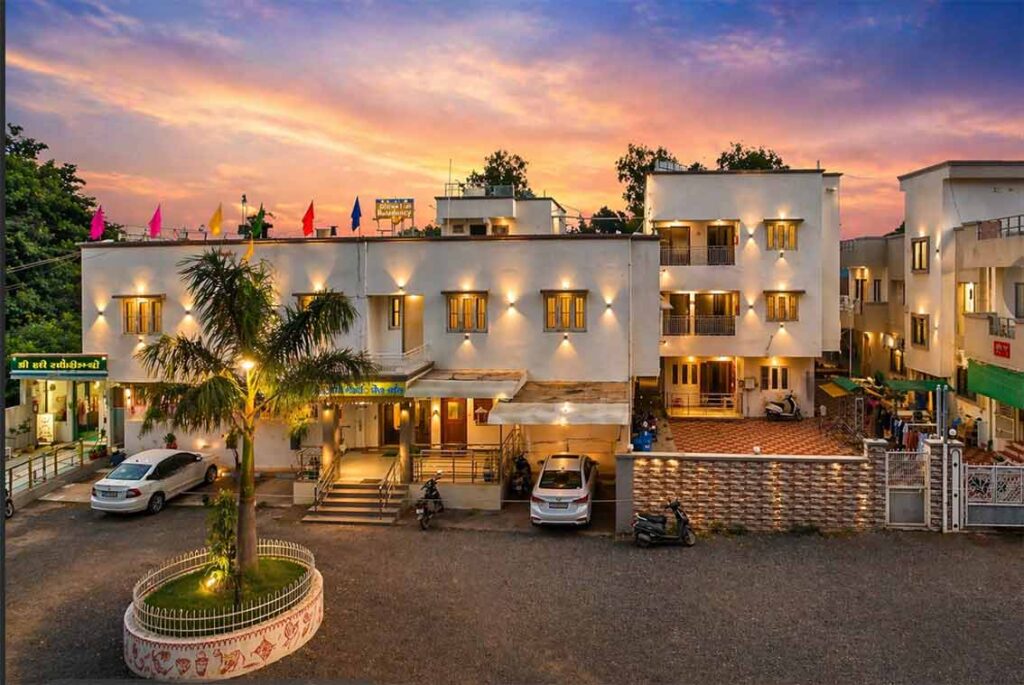
- In Halol (6 km away): this is the nearest industrial town. It offers a selection of three-star hotels and modern, affordable motels, designed for both business travelers and tourists. It represents the best compromise in terms of immediate proximity.www.hotelrajdhani.in
In the Heart of Nature: Around the Jambughoda Reserve
Ideal if you wish to combine the history of Champaner with a calm, lush, and eco-friendly atmosphere.
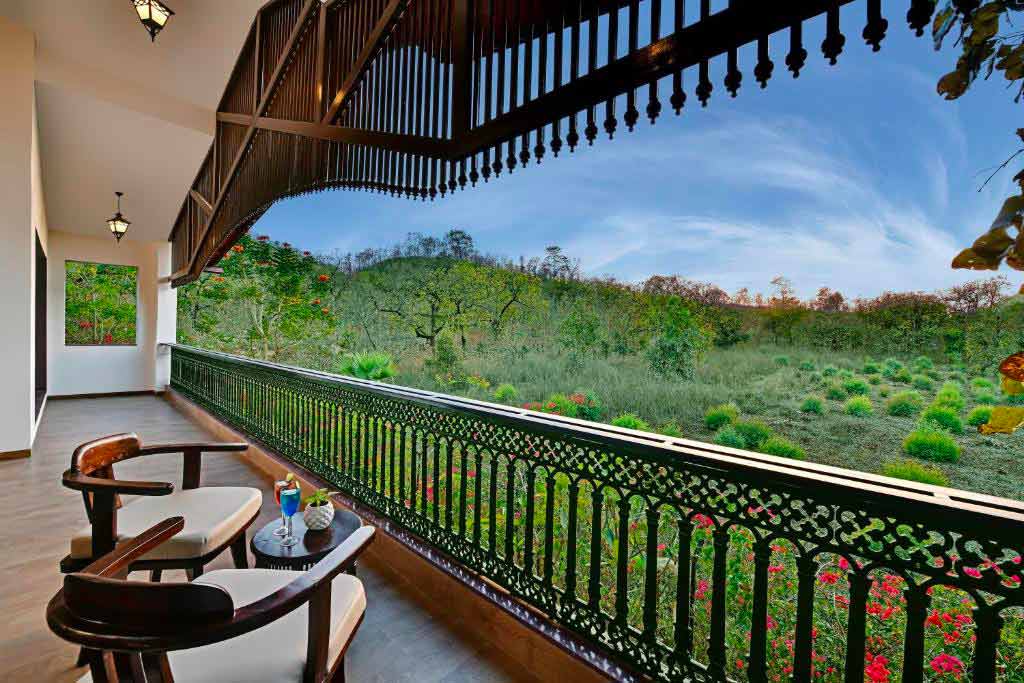
- Ecolodges and Resorts: Just outside the reserve (particularly near Lake Kada), several magnificent properties offer luxury stays with unique panoramic views. www.marriott.com
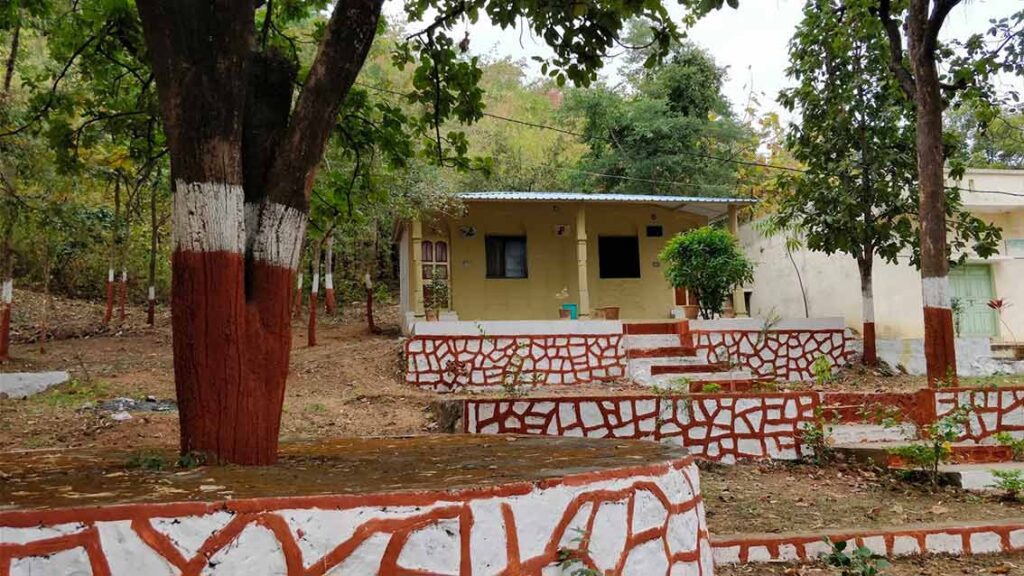
- The Gujarat Tourism “campsite”: the local tourism department offers rustic accommodations set amidst nature, ideally situated for heading off the next day to the Hathni Mata waterfalls.
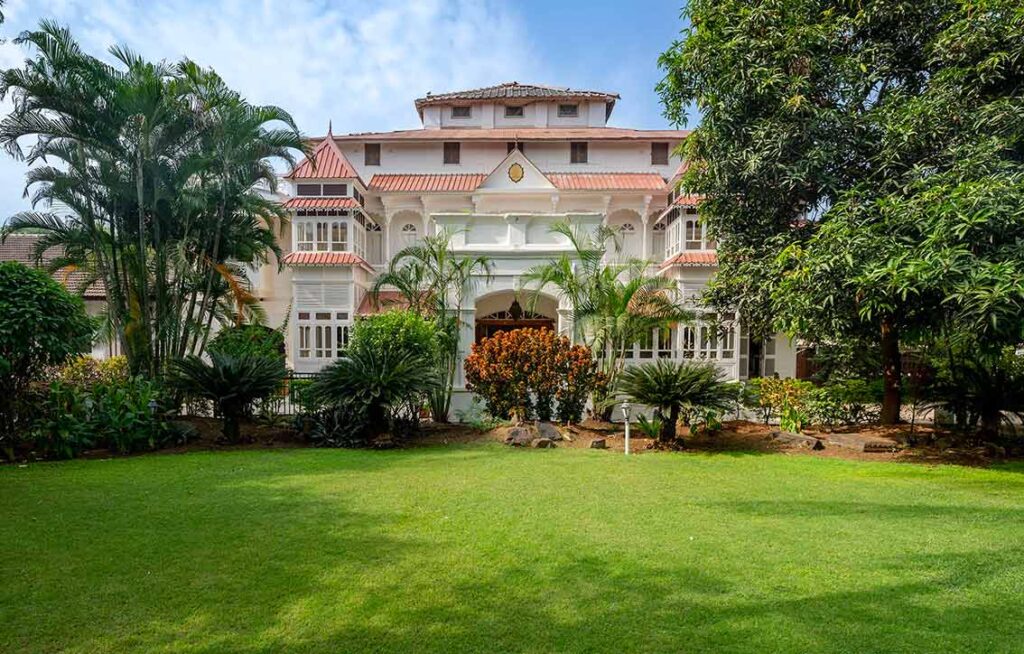
- Jambughoda Palace (my most favorite): at the edge of this wild forest stands Jambughoda Palace, the ancestral residence of the royal family of the eponymous former princely state. Built amidst lush grounds, this historic palace has preserved its period architecture and its tree-filled gardens, where peacocks roam. Now transformed into a Heritage Hotel, the estate is managed by the descendants of the maharajas, who are dedicated to preserving the local ecosystem and the traditions of the surrounding tribal communities.JAMBUGHODA PALACE.
Urban Comfort: Vadodara (50 km away)
The option chosen by the majority of travelers.
- Why choose Vadodara? The city is just a one-hour drive away via an excellent expressway. Staying here allows you to make a day trip to explore Champaner, while still enjoying the comforts of a major city in the evening.
- The Offer: You will find options across every price range, from small boutique hotels to grand international five-star palaces, as well as a multitude of restaurants where you can sample the cuisine of Gujarat.
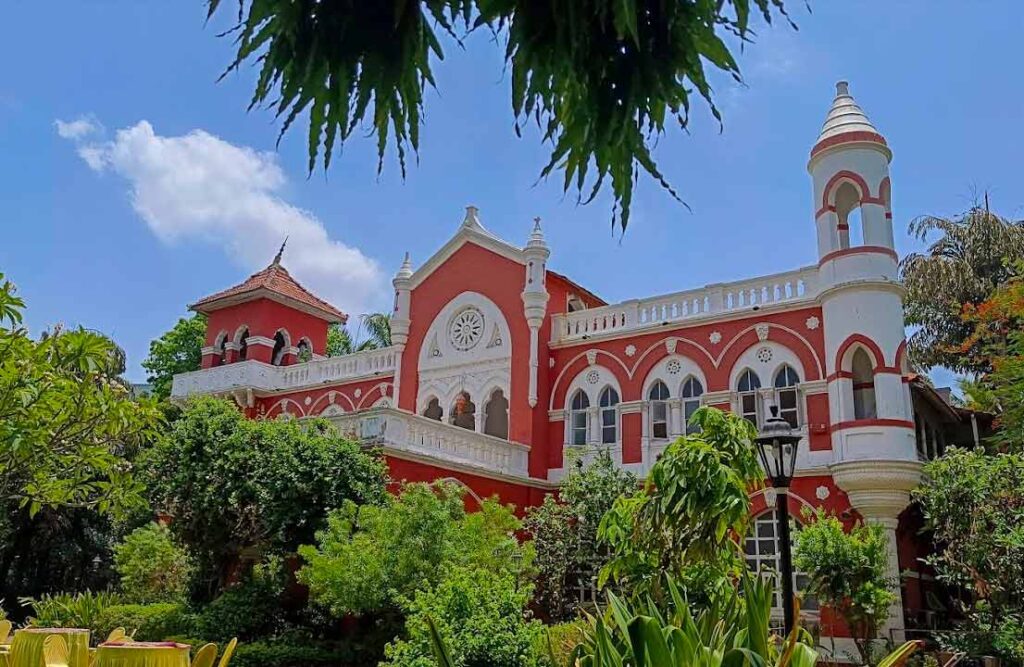
Here, too, my choice falls upon another hidden gem: the MADHAV BAUG Palace. Built in 1892 by Shrimant Madhavrao Gaekwad (cousin of Maharaja Sayajirao Gaekwad III), this magnificent Indo-Saracenic-style residence has been meticulously restored by his descendants. With just four exclusive guest rooms arranged around a central courtyard, this estate offers a complete escape amidst lush greenery. It is also a renowned culinary destination, celebrated for its royal Maratha cuisine—prepared according to ancestral aristocratic recipes.
VISIT GUJARAT WITH MY TRAVEL AGENCY!
Vous aimerez peut-être aussi...
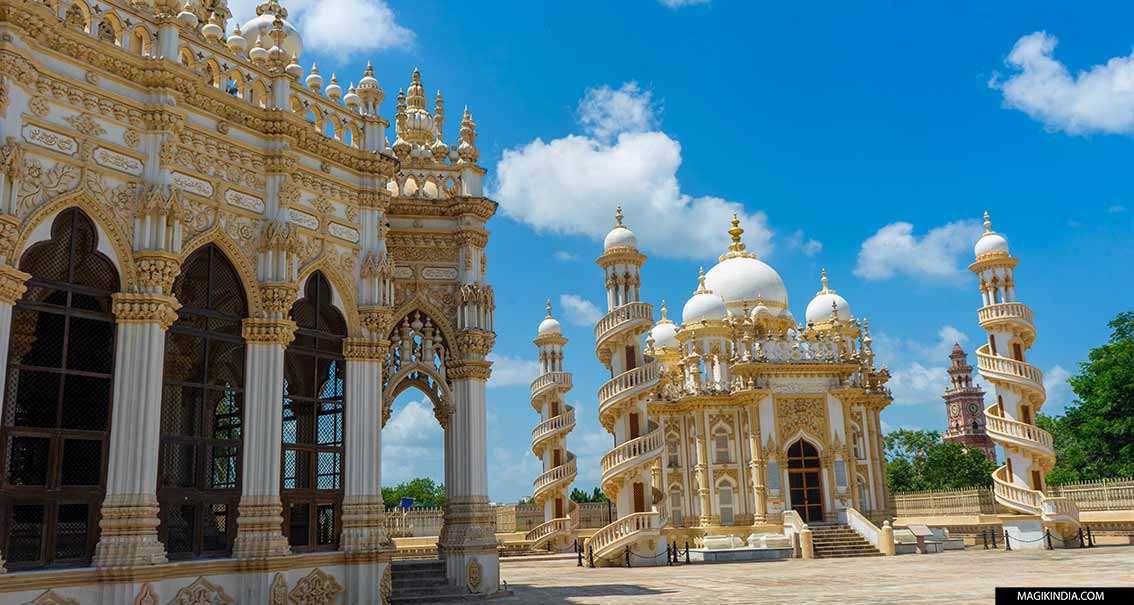
It was while finishing my story about Mount Girnar that something became obvious: I had forgotten to write about Junagadh,...
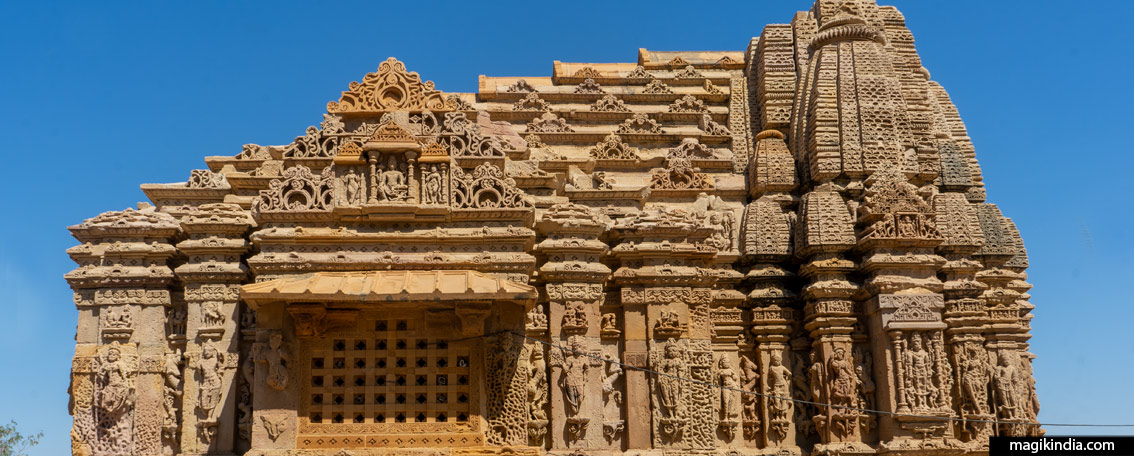
Kotay, just an hour north of Bhuj (Gujarat), boasts the remains of a temple dedicated to Surya, the Hindu sun...
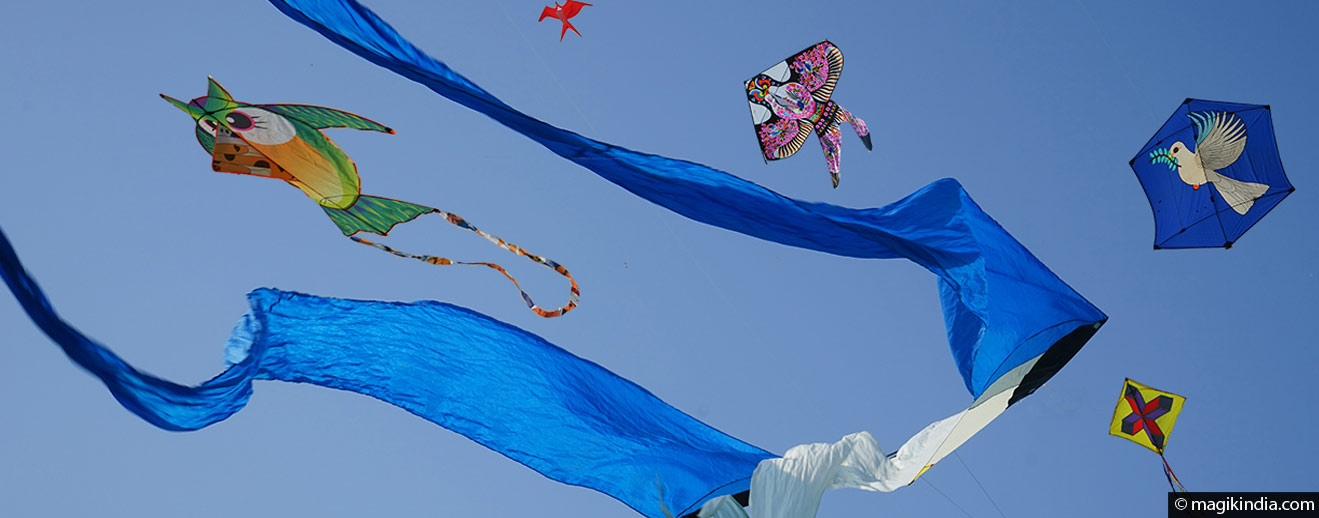
Uttarayan, the time of year when the sun starts its northward journey, is celebrated in Gujarat state with a kite...
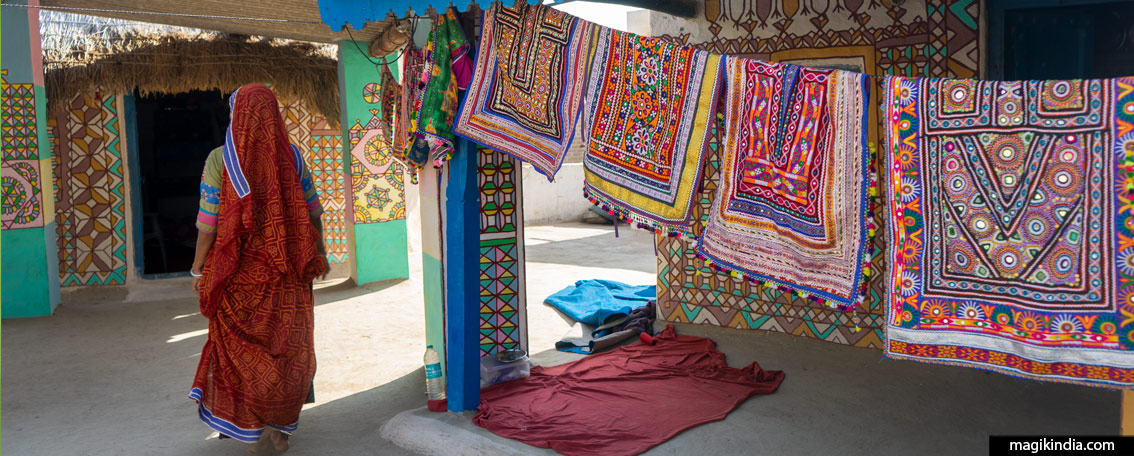
Bordered by Pakistan and Rajasthan, Kutch is an ancient land that takes its name from its turtle-like geographical features (Kachchh...
On the Shatrunjaya hill, the temples of Palitana rise like a marble prayer, caressing the heavens with their slender spires....


Hi Ankit, thanks for your message. Actually I’m not sure the rajput Pawaiya Chauhan were at Champaner at that time. Only the Khichi branch is mentioned. Regards, Mathini
Were the Pavaiya Chauhans also there when the Khichi Chauhans ruled in 1484 before Pavagarh fell to Mahmud Begada.. any info? Plz share am dying to know..
Many thanks Ananthan.
A walk through the History of Champaner and Pavagedh. Very well written and the pictures have truly justified your words.
A walk through the history of Champaner-Pavagadh. Very well written and the pictures have also added to the justification of your words