Welcome, Padharo ! I'm Mathini, a French woman who has been living in Rajasthan for 10 years. Despite being imbued with Indian culture from a young age it wasn't until 2014 that my Indian adventure really began. I left everything behind in France and set off on a 6-year journey through the land of Gandhi. These adventures are gathered in this blog which aspires, in an intentionally positive spirit, to bear witness to India's remarkably diverse and multifaceted cultural heritage. If this website sparks a desire to pack your bags and set off for an Indian adventure, it will have achieved its purpose. Subh Yatra on Magik India and beautiful explorations in the sacred land of Bharat...
Bhopal is the capital of Madhya Pradesh. Alone among the princely states of India, it was ruled by a succession of four Moslem queens, the Begums, from 1819 to 1926. The Begums made considerable infrastructure investments in Bhopal. The vestiges of Bhopal’s history worth a stop, not to forget around the amazing sites of Bhojpur, Sanchi and Bhimbekta.

According to folk tradition, Bhopal was founded in the 11th century by the king Paramara Bhoja, but there is no archaeological evidence for this.
In the early 18th century, Bhopal was a small village in the tribal kingdom of Gond. The modern town was built by Dost Mohammad Khan (1672-1728), an Afghan commander in the Mughal army.
Khan was granted the territory of Bhopal by the Gond queen Kamlapati in payment for his services as a mercenary in the unstable Malwa region (western Madhya Pradesh). When Kamlapati died he usurped her throne. In the 1720s he built a fort called Fatehgarh in the village, which grew around the fort into the town of Bhopal.

Between 1819 and 1926, under British sovereignty, the princely state was ruled by four women, the Begums (Muslim queens). This was a unique occurrence for the time, and even for our day. Under the Begums the town acquired networks of aqueducts and railways, a postal system and numerous imposing buildings such as mosques and palaces.
In 1948 the town made tragic front page news all over the world. On the night of 3 December that year, an explosion at the Union Carbide India chemicals factory released some 32 tons of toxic gas into the atmosphere. Officially, the accident killed 3828 people, a figure revised to 7575 in 1991.
According to the victim associations, the number of dead ranges between 20,000 and 25,000. It was the biggest industrial accident the world has ever known. The disaster’s impact continues today in terms of psychological and neurological illness. The groundwater and the soil around the site are still contaminated with toxic residues.

Taj-ul-Masajid means “crown among mosques”. It is one of Asia’s largest mosques.
Its construction was launched by Nawab Sultan Shah Jahan Begum (1844-1860 and 1868-1901) and continued in the reign of her daughter Sultan Kaikhusrau Jahan Begum.
The mosque was not completed during the latter’s lifetime for lack of funds. It was only finally completed in 1985.

Taj-ul-Masajid boasts a pink façade from which rise two 62m octagonal minarets topped by marble domes. The main prayer hall boasts finely carved pillars and a Mughal style marble floor like the one at Jama Masjid in Delhi.


TheBada Talab or the Upper Lake is a vast stretch of water on the western edge of Bhopal, bordered on its southern side by the Van Vihar national park.
The lake is a quiet place where visitors can enjoy boat trips and water sports.

Bhopal’s museum is one of the largest in Madhya Pradesh.
Its 17 galleries house historic objects including the royal collection, fossils, prehistoric artefacts, sculptures and textiles.
The museum provides a kind of flash-back across the history of Madhya Pradesh.


Beside the Upper Lake stands the Gohar Mahal, built in 1820 by the first woman to rule Bhopal, Sikander Jahan Begum.
The palace traversed the entire period of the Begum rulers and has now been converted into a cultural centre.
Every year the Madhya Pradesh tourist authority holds the Bhopal Mahotsav in the Gohar Mahal. This is a festival of theatre, crafts and music.
The pink Gohar Mahal is a fine example of the fusion of Mughal and Hindu architectural styles.


The Shaukat Mahal and the Sadar Manzil are well orth a viit, though their dilapidated condition is a great pity.
They are near the entrance to the Chowk (market) in the town centre. Both buildings are architectural curiosities.
The Shaukat Mahal was built in 1830 as a wedding gift for Sikander Jehan Begum, the first woman to rule Bhopal.

It was designed by a French descendant of the Bourbon royal dynasty. The building is a harmonious blend of Muslim architectural styles with European Gothic and Post-Renaissance elements.
Beside the Shaukat Mahal stands the Sadar Manzil, which served as a public audience hall during the princely period


The Bhopal Taj Mahal was built as the main residence of the reigning Begums. Building was started by Shah Jahan Begum and took 13 years, from 1871 to 1884.
At the time, it was one of the world’s largest palaces. It is said that the Begum ordered a ‘Jashn-e-Taj Mahal’, i.e. three years of celebrations after the building was completed.

The palace fell into disuse after India’s independence. Although much of it is now dilapidated, one can easily see how splendid it must once have been.
In 2005 it was declared State heritage by the Madhya Pradesh government and the Department of Archaeology has started restoration work. But some say it is to be converted into a luxury hotel.

The architectural style of the Bhopal Taj Mahal is Indo-Saracenic, mixing British, French, Mughal, Arab and Hindu features.
It comprises 120 rooms, a hall of mirrors, the ‘Sawan Bhadon’ pavilion and an elaborate fountain that simulates the effect of rain. The main entrance is a seven-storey structure.

The Taj Mahal was one of a complex of buildings along the banks of the three lakes, the others being the Benazir Palace (the Begums’ summer palace) and the Taj-ul-Masjid mosque.


The Moti Masjid (‘small mosque’), also known as the ‘pearl mosque’, is in Bhopal town centre.
The Moti Masjid was built in 1860 on the orders of Sikandar Jehan Begum, the daughter of Qudisiya Begum.
This elegant mosque is built of red brick, contrasting with its white marble façade. Two small cupolas surmount the mosque and the red minarets on either side end in gold spikes.

Lakshmi Narayan temple stands on the Arera hills of Bhopal. It is also known as the Birla Mandir because it was built by the Birla family of industrialists.
It is dedicated to the goddess Lakshmi accompanied by her spiritual spouse Vishnu. It also houses a shrine dedicated to Shiva and Parvati, and the Birla Museum, which boasts a fine collection of sculptures from sites around Madhya Pradesh.

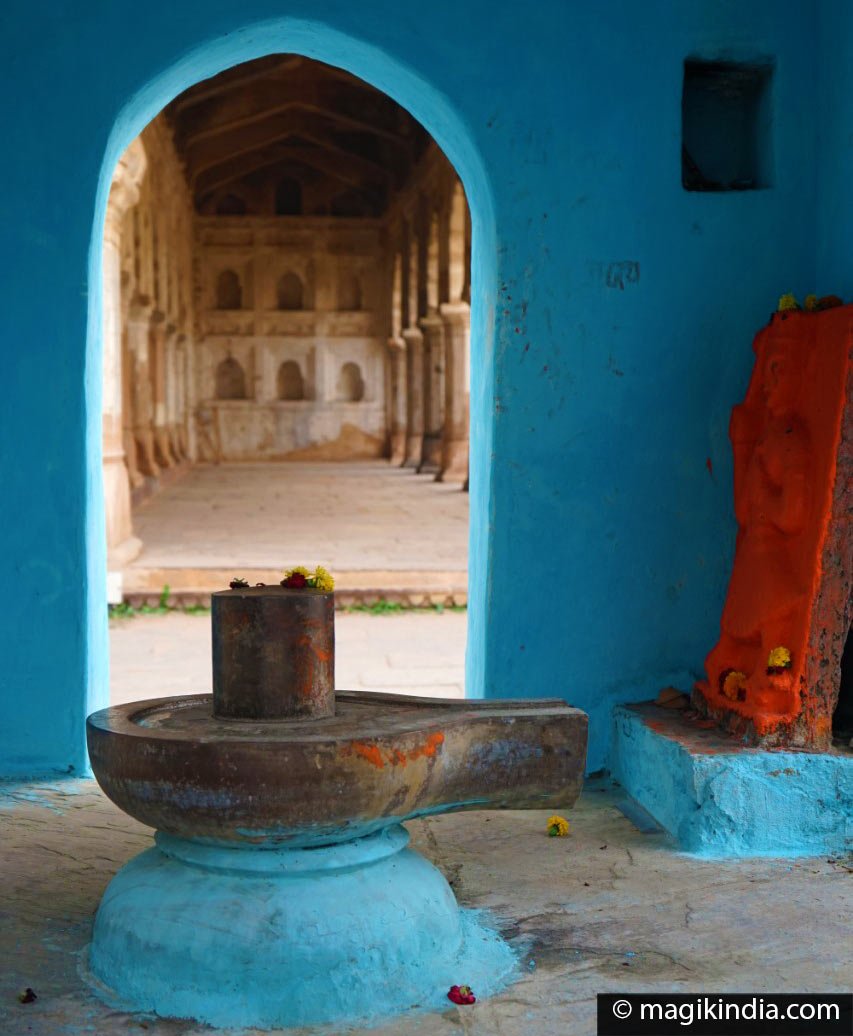
Bhojeshwar is an uncompleted Hindu temple in Bhojpur village, 28km from Bhopal. It is dedicated to Shiva and houses a 2m lingam, one of the tallest in India.
A huge, rough, blocky structure from afar, the temple reveals its delicacy as you approach. It is one more monument in India’s long list of architectural wonders…
LIRE LA SUITE +
Classified as a World Heritage Site, Bhimbetka is an archaeological site nestled in a natural setting 45km from Bhopal. This site contains various rock shelters showing cave paintings dating back some 28,000 years!

Most of these works from another era were executed using red and white pigments, more rarely green and yellow. They represent hunting scenes, dances, men riding elephants and horses, collecting honey, wearing body decorations and masks. There are also scenes from everyday life, animal fights.


Sanchi, a small village 46km northeast of Bhopal, is famous for its splendid group of Buddhist monuments, some of which date back to the 3rd century BCE. It is the oldest Buddhist sanctuary in existence and remained a major centre of Buddhism in India until the 12th century…
LIRE LA SUITE +The World Music Festival in Udaipur, city of lakes, achieved its goal at its first edition in February 2016: it is henceforth a reference in South Asia and a must-go event for fans of World Music.
The idea behind the festival is to make Udaipur a must-go destination on the World Music scene. Conception and production are by Seher, which has already created a number of festivals in India, its best-known being Ananya, Bhakti Utsav and South Asian Bands.
Festival director Sanjeev Bhargava says: “A festival of this scale featuring such diverse music from so many different continents and regions coming together in one of the best Tourist destinations of India would make Udaipur a culturally vibrant destination. An annual event where International and domestic travelers can mark the dates on their yearly travel calendar.”
The well-conceived, eclectic programme for the first edition in February 2016 featured a hundred artists and musicians from 12 countries including France, Ghana, India, Italy, Portugal, Spain and Venezuela.
The festival not only lived up to its promise in terms of quality and geographical sweep, it also helped boost access to culture because all the concerts were free. Indian audiences danced to the electrifying beat of Dobet Gnahoré and were amazed by the flamenco with its lascivious entwinement of bodies, which they saw for the first time.
It was a shame that (as so often in India) so much space was given over to VIP seats, which cut the public off from the stage and the artistes from their audience. Maybe that will be improved next time around.
[ Share 🙂 ]
Bhojeshwar is an uncompleted Hindu temple in Bhojpur village, 28km from Bhopal. It is dedicated to Shiva and houses a 2m lingam, one of the tallest in India. A huge, rough, blocky structure from afar, the temple reveals its delicacy as you approach. It is one more monument in India’s long list of architectural wonders.
Breakfast in India is usually savoury and spicy. It’s a full meal and often versatile, some dishes being suitable for any time of day. Here is a selection of the most popular indian breakfasts.
Each February, the World Sacred Spirit Festival brings together eminent musicians from all over the world to explore the sacred through different forms of art from music and chant to dance and poetry. A festival of Sufi-inspired devotional music set in the magical and prestigious sites of Ahhichatragarh in Nagaur and Mehrangarh Fort in Jodhpur.
A selection of the most popular non-alcoholic beverages of India.

Let’s start by the most popular beverages of India: chai tea!
Chai is a black tea with milk and a good dose of sugar :). Mixed with spices, it takes the name of “masala chaï”. The word chai (tea in Hindi) is the name given in the north of India, in Tamil Nadu it is called Teythani or Teyilai.
There is no fixed recipe or preparation method for masala chai and many families have their own versions of the tea. Most chai contains 1/3 of black tea. Usually, a specific type of Assam is used called “mamri”, a granuled tea.
For a masala chai, the spice mixture, called Karha, uses a base of ground ginger and green cardamom pods. Other spices are usually added to this base like cinnamon, star anise, fennel seeds, peppercorn, nutmeg, cloves and also lemongrass and mint like in Gujarat. Certain type of spices will be used according to the season.
Indian coffee is made by mixing frothed and boiled milk with coffee powder in a traditional Indian filter.
The drink is also known as kaapi (the South Indian phonetic rendering of “coffee”). Outside India, the term “filter coffee” may refer to drip brew.
The most commonly used coffee beans are arabica and robusta of South India hills.
In South India, the coffee is drunk from the tumbler but is often cooled first with a “dabarah” a wide metal saucer with lipped walls.
Another famous drink of India. Lassi is a blend of yogurt and water.
Traditional lassi is a savoury drink, sometimes flavoured with ground and roasted cumin.
Sweet lassi, however, contains sugar or fruits, instead of spices. Lassis are enjoyed chilled as a hot-weather refreshment, mostly taken with lunch.
Chaas, pronounced ‘Chaach’ is a yogurt-based drink popular across India. It is a kind of buttermilk.
Chaas is made by churning yogurt and cold water together in a pot, using a hand-held instrument called madhani (whipper).
This can be consumed plain or seasoned with a variety of spices.
Chaas is very close to Lassi, with two major differences: Chaas is more dilute (with water) than lassi and unlike lassi, Chaas does not have added sugar.
Chaas can be consumed plain, but a little salt is usually added. Numerous other seasonings and spices can be added to salted Chaas, either singly or in combination with each other. The spices which can be added thus are: Coarsely ground and roasted cumin seeds, curry leaves, asafoetida, grated ginger, very finely diced green chillies and Mustard seeds.

Coconut water has long been a popular refreshing drink in the tropical countries.
Coconut water is the clear liquid inside young green coconuts (fruits of the coconut palm). Fresh coconuts are typically harvested from the tree while they are green. A hole may be bored into the coconut to provide access to the liquid and meat.
They are often sold by street vendors who cut them open with machetes or similar implements in front of customers.
In recent years, coconut water has been marketed as a natural energy or sports drink having low levels of fat, carbohydrates, and calories, and significant electrolyte content. However this is disallowed by certain regulatory agencies.

Sugarcane juice is the juice extracted from pressed sugarcane. It is obtained by crushing peeled sugar cane in a mill.
It can be a hand-cranked machine, or powered. It is served, often cold, and sometimes with other ingredients, such as a squeeze of lemon, black salt or mint.
The juice is very healthy and tasty but you have to be very careful about hygienic conditions.

Shikanjvi or Nimbu Pani is a type of traditional lemonade from North India.
While the base ingredients include lemon or lime juice and sugar, shikanjvi often contains other ingredients such as chaat masala, salt, saffron and cumin.
Indian desserts, like the country itself, are colourful and infinitely varied. There are two kinds of desserts in India, those based on milk, like rasgula, rasmalai and burfi, and those based on flour, like gulab jamun, halwa and ladoo. Either way, there’s no stinting on sugar and oil. 🙂
Here is a selection of some of the most popular desserts of India
Kheer is a rice pudding made by boiling rice or broken wheat, tapioca, vermicelli with milk and sugar.
It is flavoured with cardamom, raisins, saffron, cashews, pistachios or almonds.
It is typically served during a meal or as a dessert. It is also known in some regions as payasam (South India).
Kheer is also served as an offering to the Gods in Hindu temples during rituals and ceremonies.
Gulab Jamun is one of the most popular desserts in India. It is a milk-solids-based dessert called khoya.
Milk solids are prepared by heating milk over a low flame for a long time until most of the water content has evaporated.
The khoya is then kneaded into a dough, sometimes with a pinch of flour, and then shaped into small balls and deep-fried at a low temperature of about 148 °C.
The balls are then soaked in a light sugary syrup flavored with green cardamom and rose water, kewra or saffron.
Gulab jamun is usually served at weddings and birthday parties.
Kulfi is a popular frozen dairy dessert. It is often described as the indian ice cream.
As popularly understood, Kulfi has similarities to ice cream in appearance and taste; however it is denser and creamier.
Unlike Western ice creams, kulfi is not whipped, resulting in a solid, dense frozen dessert similar to traditional custard-based ice cream. It comes in various flavours.
The more traditional ones are cream (malai), rose, mango, cardamom (elaichi), saffron (kesar or zafran), and pistachio.
Another very famous dessert of India. Laddu or laddoo are ball-shaped sweets popular in all the Indian Subcontinent.
Common flours used for laddu include besan (chickpea flour), rava (wheat semolina) and ground coconut. These are combined with sugar and other flavorings, cooked in ghee and molded into a ball shape. Nuts such as pistachios and almonds are commonly stuffed into laddus.
Laddu is often prepared for festivals or family events such as weddings and births, or given as a prasad (sacred food) at Hindu temples, especially to Ganesha, the elephant-headed deity.
Barfi is a dense milk based sweet confectionery, a type of mithai. The name is a derivative of the Persian word barf, which means snow.
A few of the famous varieties of barfi include besan barfi (made with gram flour), kaaju barfi (made with cashews), pista barfi (made with ground pistachios), and sing barfi (made with peanuts).
The main ingredients of plain barfis include condensed milk and sugar. The ingredients are cooked in a vessel until the mixture solidifies.
Barfis are usually coated with a thin layer of edible metallic leaf known as vark.
The confection is served all year round, but especially consumed during the holiday seasons, wedding ceremonies, and the religious festivals like Diwali, the Hindu festival of lights.
Gajar ka halwa also known as gajrela is a sweet dessert pudding associated mainly with the North India.
There are many variations of gajar ka halwa, but its main ingredients are freshly grated carrots, milk, sugar, khoya (condensed milk), and ghee (clarified butter).
It is often served with a garnish of almonds and pistachios or cashew nuts which are first sautéed in ghee.
Rasgulla is a syrupy dessert made from ball shaped dumplings of chhena (an Indian cottage cheese) and semolina dough, cooked in light syrup made of sugar.
The dish originated in East India; the present-day states of Odisha and West Bengal are variously claimed to be the birthplace of the dish.
Chhena is created in a similar process to paneer cheese except it is not pressed for as long.
Jalebi, also known as Zulbia, is a very famous sweet throughout all India but also in the Middle East and Africa.
It is made by deep-frying a wheat flour (maida flour) batter in bretzel or circular shapes, which are then soaked in sugar syrup. They are particularly popular during Ramadan and Diwali.
Most Indian breads are flatbreads, made without leavening and cooked on a flat or concave pan called a tava or fried in oil. Bread is a staple of the Indian diet, especially in the North where a meal without chapatis is almost unthinkable.
I make a small aside concerning the flours used in India.There is a wide variety of them but wheat flour, rice, lentils, chick peas and corn are the most commonly used.
Gluten-free and rich in protein, lentil flours are commonly used in India. Here are the best known:
Rice flour (chawal ka atta)
It can be made from white or brown rice. In southern India, it is a component of several breads like idli and dosa.
Corn flour is the most consumed flour after wheat flour, tied with rice flour. It is involved in many dishes and breads like “ki roti maki” the favorite Punjab bread consumed during the winter season.
Let’s start by the most common bread of North India. Chapati is an unleavened flatbread (also known as roti) made out Atta flour and cooked on a tava (flat skillet).
The word chapat in Hindi means “to slap”, and the traditional method of forming rounds of thin dough is by slapping the dough between the wetted palms of the hands. With each slap, the round of dough is rotated.
Often, the top of a chapati is slathered with butter or ghee (clarified butter). A piece of chapati is torn off and used to pick up the ingredients that make the meal.
A paratha is a flatbread that originated in the north of the Indian Subcontinent. It is still quite prevalent in the north of India, where wheat is grown and is the traditional staple of the area.
Paratha is an amalgamation of the words “parat” and “atta” which literally means layers of cooked dough. Parathas are thicker and more substantial than chapatis/rotis and this is either because, in the case of a plain paratha, they have been layered by coating with ghee or oil and folding repeatedly
Parathas can be eaten as a breakfast dish or as a tea-time (tiffin) snack.
Poori is an unleavened deep-fried Indian bread, commonly consumed on the Indian subcontinent. It is eaten for breakfast or as a snack or light meal.
It is usually served with a curry or bhaji. Poori is prepared with wheat flour, either atta (whole wheat flour), maida (refined wheat flour), or sooji (coarse wheat flour). Maida flour is the most common flour used in making Pooris.
A dough of flour and salt is either rolled out in a small circle or rolled out and cut out in small circles and deep fried in ghee or vegetable oil. While deep frying, it puffs up like a round ball because moisture in the dough changes into steam which expands in all directions. When it is golden-brown in color, it is removed and may be served hot or saved for later use.
Bhatura is a fluffy deep-fried leavened bread from North India.
A typical recipe includes white flour (maida), yogurt, ghee or oil, and either yeast or baking powder. Once kneaded well, the dough is left to rise, and then small balls of it are either hand-rolled or flattened using a rolling pin. Then the bread pieces are deep fried until they puff up into a lightly browned, soft, fluffy bread, which is elastic and chewy.
It is often eaten with chickpea curry (chole), making the traditional dish ‘chole bhature‘.
Dosa is a fermented crepe made from rice batter and black lentils. It is a staple dish in South Indian.
A mixture of rice and urad dal that has been soaked in water is ground finely to form a batter. Some add a handful of fenugreek seeds soaked along with the rice. The proportion of rice to lentils is generally 4:1 or 5:1. The batter is allowed to ferment overnight.
After the overnight fermentation, the batter is mixed with water to get the desired thickness. The batter is then ladled onto a hot tava (griddle) greased with oil or ghee (clarified butter). It is spread out evenly with the base of a ladle or bowl to form a pancake. A dosa is served hot, either folded in half or rolled like a wrap.
It is also usually served with chutney and sambar.
Naan is a leavened, oven-baked flatbread. Generally, it resembles pita and, like pita bread, is usually leavened with yeast or with bread starter (leavened naan dough left over from a previous batch);
unleavened dough (similar to that used for roti) is also used. Naan is cooked in a tandoor, from which tandoori cooking takes its name. This distinguishes it from roti, which is usually cooked on a flat or slightly concave iron griddle called a tava.
Typically, it is served hot and brushed with ghee or butter. It can be used to scoop other foods, or served stuffed with a filling.
A parotta is a layered flatbread made from maida flour, from the culinary tradition of parts of Southern India, especially Tamil Nadu as well as Kerala.
Parottas are usually available as street food. It consists in thin multiple layers which are flaky and smooth at the same time.
It is usually eaten with different curries.
Papadum or papad is a thin, crisp disc-shaped food typically based on a seasoned dough usually made from peeled black gram flour (urad flour), fried or cooked with dry heat.
Flours made from other sources such as lentils, chickpeas, rice, tapioca or potato, can be used.
Papadums are typically served as an accompaniment to a meal or as an appetizer or snack, sometimes with toppings such as chopped onions, chopped carrots, chutneys or other dips and condiments.
Baati is a hard, unleavened whole-grain wheat bread of Rajasthan.
The procedure for making Baatis is very different than any North Indian bread. Traditionally Baatis are first boiled in the water and then baked in the clay oven (Tandoor) or grill.
Baati is usually eaten with dal, hence the dish ‘dal baati‘.
Makki di roti or Makhai ki roti is a flat, unleavened Punjabi bread made from corn flour.
Like most breads in indian cuisine, it is baked on a tava. Makki di roti is generally made during winter in Punjab and is perhaps best known when accompanied with saag (a leaf-based dish like spinach, mustard leaf…), makkhan (butter) and buttermilk (chaas)
Czot is a popular soft bread of Kashmir prepared in tandoor (earth oven) and made of Atta flour. It is usually used as breakfast with salted butter and cinnamon tea. A real treat. During Ramzan or Ramadan it is the only bread that is baked. In Kashmir, the tradition is to served Czot with meat when happy events occur like marriage or new born baby.