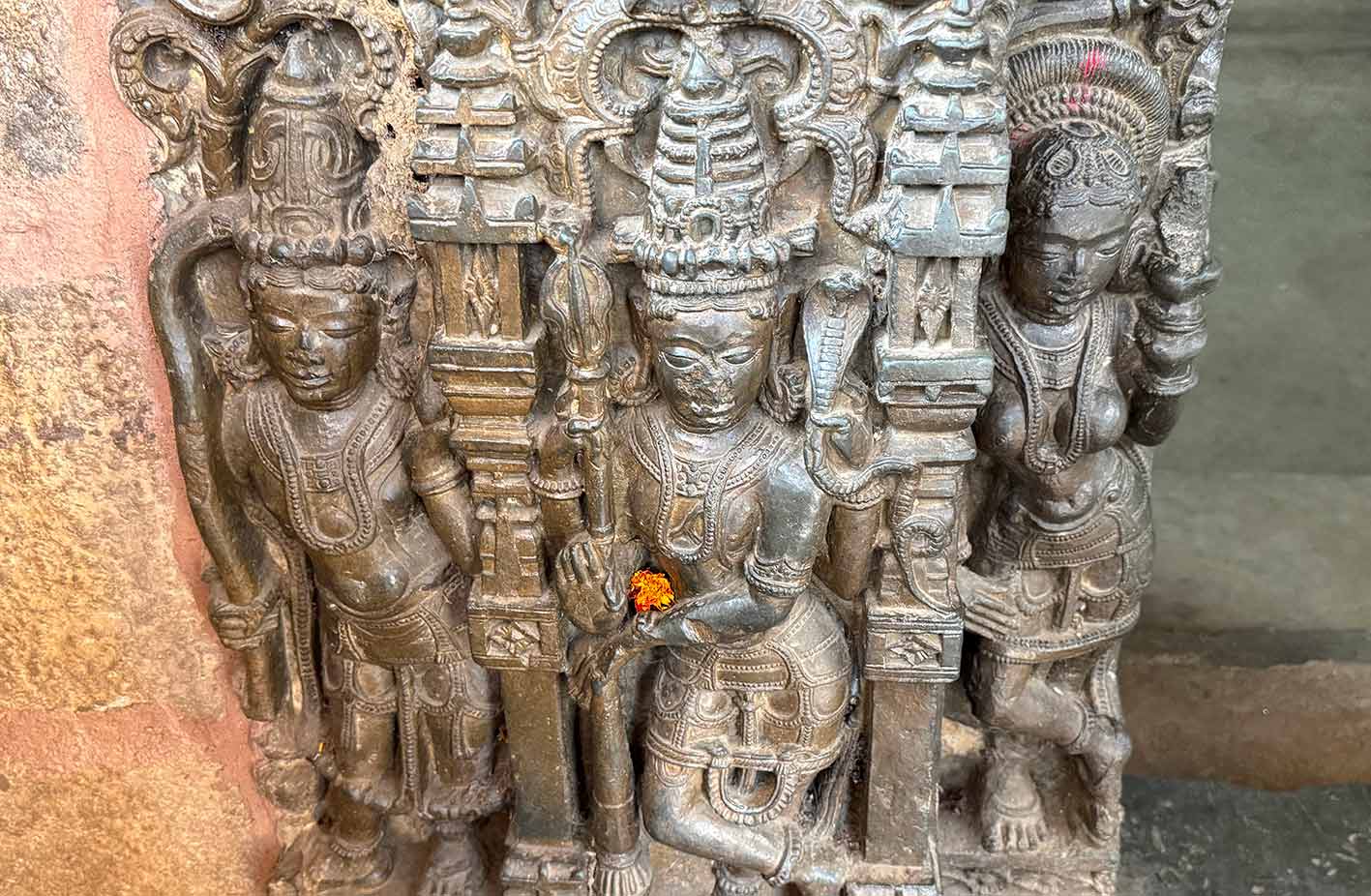
In the hollow of the wooded hills of the Maikal range, in the wild setting of Chhattisgarh, the Bhoramdeo temple...

Kutia Kondh Tattoos: A Celestial Passport
In the isolated mountains of the Kandhamal district in Odisha, a geometry of lines and dots traces a sacred alphabet upon the faces of Kutia Kondh women. Far more than a mere adornment, this graphic design constitutes a veritable passport of the skin, an armor against the invisible during life and subsequently an indispensable seal ensuring that the ancestors recognize their own once the threshold to the spirit world has been crossed.
The Emergence of the Earth: The Mythology of Nirantali
The origins of the Kutia Kondh are lost in the mists of time, blending deep anthropological roots with a fascinating mythology in which man is literally born from the very earth he cultivates. Anthropologically, the Kutia Kondh belong to the Proto-Australoid group, much like the Bonda and the Dongria, and are counted among India’s so-called “Adivasi” (first inhabitants) populations.
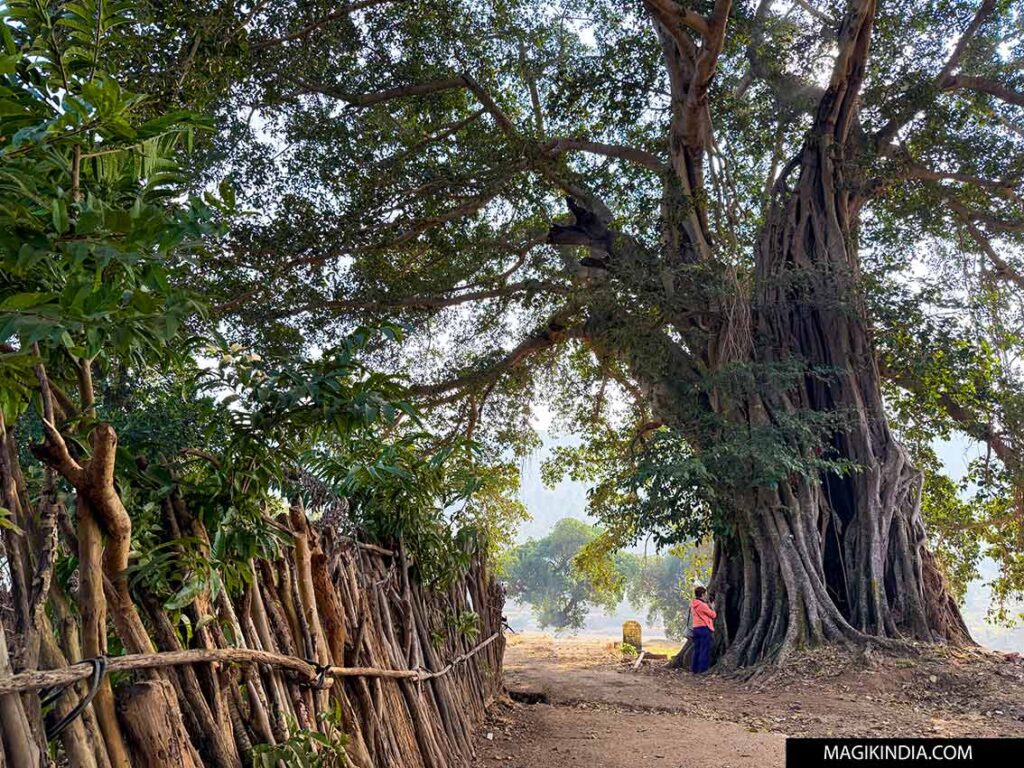
For the Kutia, the history of their community begins with a divine birth. According to their oral traditions, at a time when the world was nothing but chaos and darkness, the deity Nirantali structured the universe by separating the waters from the land. From the depths of a sacred cave, she brought forth the first seven ancestors, thereby establishing the identity of the Kondh as a people born from the very soil itself. To enable them to communicate, she created their language, Kui, from the rustling of the leaves of a sacred banyan tree, binding their speech to the breath of nature.

The source of all civilisation, Nirantali subsequently imparted to them vital knowledge: the cultivation of millet, the worship of the Earth Goddess (Dharani Penu), and the sacred art of tattooing. By establishing these rites, the goddess sealed an eternal pact of reciprocity, wherein man must nourish, through sacrifice, the earth that sustains his life and carries his voice.
The Tattoo-Passport of the Kutia Women
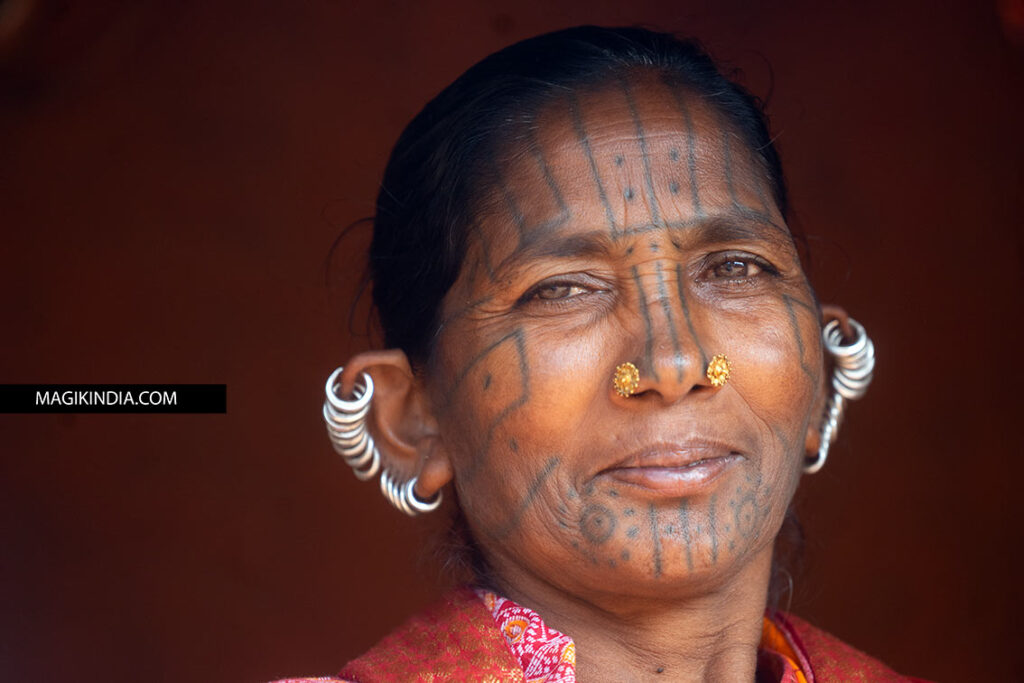
The faces of Kutia Kondh women undoubtedly offer one of the most striking testimonies to the sacred art of tattooing. Among the Kutia Kondh, facial tattooing is far more than mere aesthetic adornment: it is a complex rite of passage, a form of spiritual protection, and a profound mark of identity.

Recognition in the Afterlife
This is the most fundamental belief. For the Kutia Kondh, ink is the soul’s only baggage. While the flesh returns to the earth, these sacred markings endure to serve as a safe conduct to the ancestors. This marking is a vital necessity to avoid wandering eternally: “It is our compass for rejoining our ancestors when we leave this world,” they confide. Without this tribal seal, the spirit would remain a stranger among its own kind.

This vision of the afterlife sometimes takes unexpected forms. In both Odisha and Chhattisgarh, certain tribes view the stranger as a celestial traveler. What I initially took for a jest on the part of our guide transformed, in an instant, into a moment of profound emotion when a Kutia woman with deep sincerity asked us to convey her greetings to her late father once we had “returned up there”…

The Marking of Maturity and Courage
Tattooing is traditionally practiced as puberty approaches. It is a test of endurance, as the process is painful: it is performed using iron needles or plant thorns, with an ink made of lamp soot mixed with plant sap. Enduring the pain without crying out serves as proof that the young girl is ready for the responsibilities of adult life and marriage.

Geometric Symbolism
Far from being random, this geometry of lines and dots adorning the face constitutes a veritable cartography of life. Each stroke draws its source from the environment of the Kutia Kondh: the furrows traced in the earth, the benevolent sun, or the stripes of the tiger. By bearing these marks, they physically embody fertility and devotion to the nurturing soil.

Under the pressure of modernity and out of fear of outside scrutiny, young women are now turning away from this ancestral rite. Facial tattooing is gradually fading from the lineages: only women of a certain age still wear these masks of dots and lines.
From the Meriah to the Kedu
Until the mid-19th century (before British intervention and colonial missions), the Kondh practiced human sacrifice to appease Dharani Penu.

The victim (Meriah) was never a member of the clan. She was often purchased or captured from other communities. She was treated with immense reverence, sometimes even married within the village, prior to the fateful day. It was believed that the victim’s blood imparted its red color to turmeric (their primary crop) and guaranteed universal fertility. Under pressure from colonial authorities, the buffalo (in the Kedu ceremony) replaced the human victim. The ritual retained its symbolic structure, but animal life took the place of human life.

The Kedu is the most important ceremony of the Kutia Kondh. It is not held annually in every village, but rather rotates according to the needs or wishes expressed by the elders.
The wooden sacrificial post (yupa) is erected in the center of the village. It represents the axis of the world and the link to the divine. The village shaman (Jani) and the priestess (Peju) enter a trance to the sound of drums and flutes. They invoke the spirits of the forest and the mountains.

The buffalo is tied to the post. Amidst intense collective fervor, the animal is sacrificed. Traditionally, every family attempts to collect a small amount of blood to immediately pour it onto their own field, in order to nourish Mother Earth.

Between Ancestral Seal and New Destiny
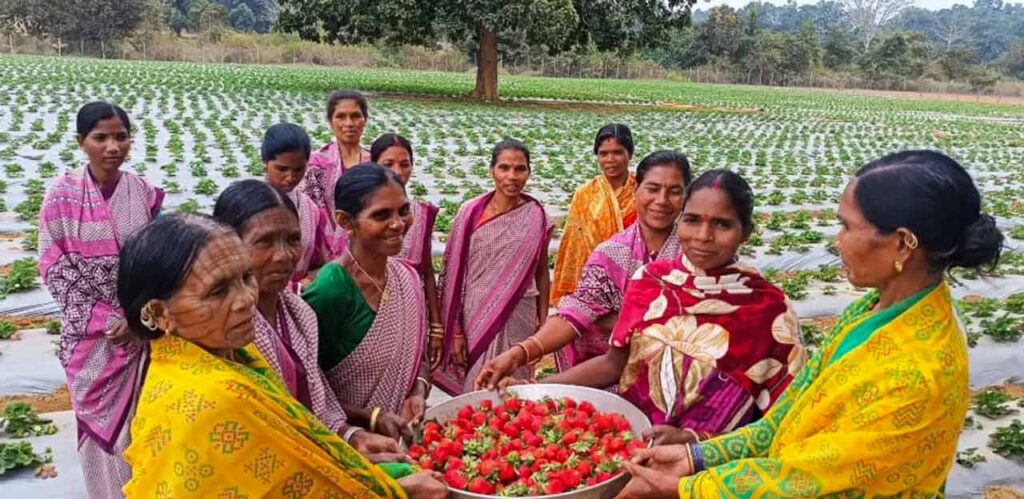
While modernity prompts younger generations to abandon facial tattooing in order to escape stigmatization, the identity of Kutia Kondh women does not fade away; rather, it undergoes a metamorphosis. In the Kandhamal hills, a new chapter is being written, driven by the impetus of Mission Shakti. This government empowerment program is transforming villages into a vast network of economic solidarity.

Today, Kondh women are trading their “cutaneous passport” for unprecedented autonomy. By taking the reins of micro-enterprises and leveraging their expertise in forest resources, they prove that one can embrace the future without betraying one’s roots. The mark of the ancestors may be fading from their faces, but the resilience of Dharani Penu now beats within the heart of this new sisterhood.
Vous aimerez peut-être aussi...
Lost in the middle of the tumultuous currents of the Brahmaputra, the island of Majuli is a world apart. As...

If Gujarat captivates me, it is above all by the human richness of its communities. After exploring the world of...

The Santhal people constitute one of India's largest indigenous communities, primarily settled in the states of Jharkhand, West Bengal, Odisha,...

Imagine a kitchen utensil capable of rivaling Teflon, yet born of the earth, long before the industrial era. Deep within...

Some forms of art do not merely traverse time; they suspend it. Deep within the tribal strongholds of India, where...

