

Three hours away from Ahmedabad, the Tarnetar fair comes alive as one of Gujarat's most dazzling rural spectacles. Fusing ancient...
Mata Ni Pachedi: When Cloth Becomes a Temple
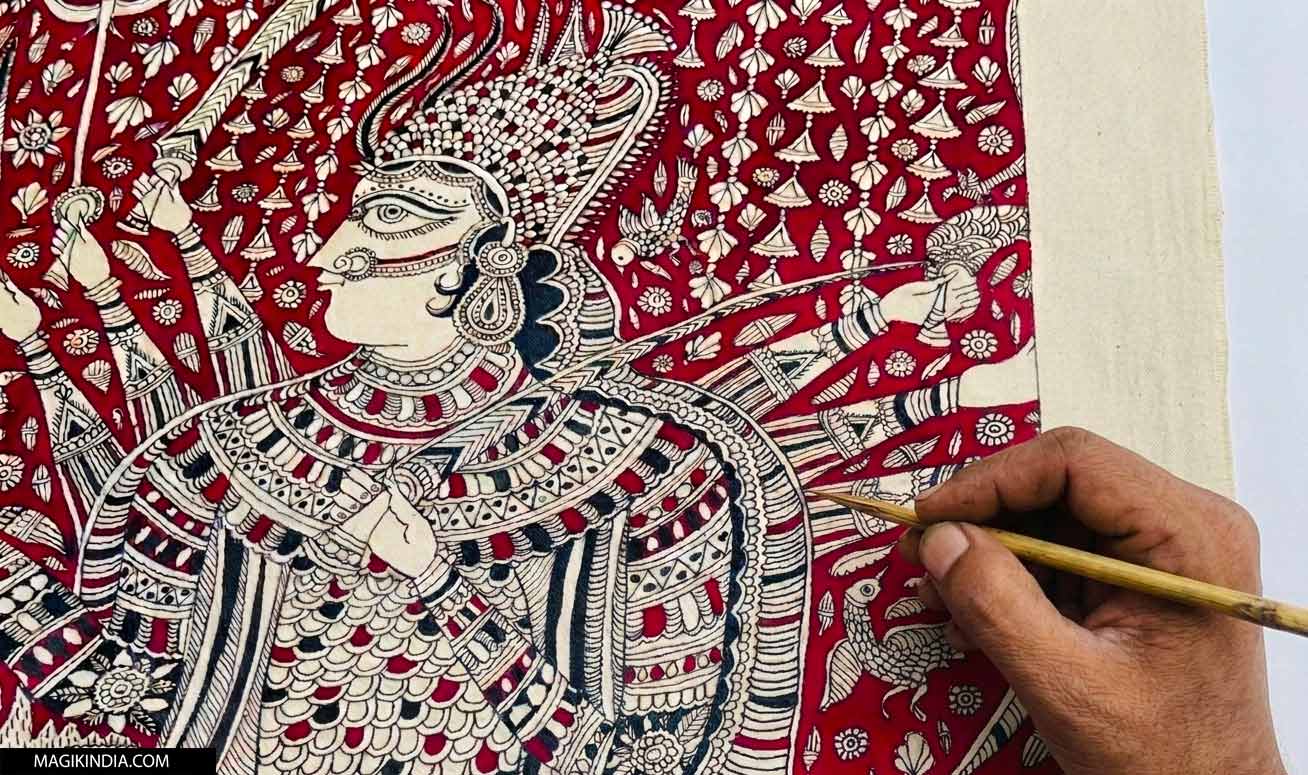
The Mata ni Pachedi, literally “the goddess in the background,” is the triumph of fervour over exclusion. Invented by the Vaghari nomads, deprived of temples, this textile art made cotton canvas the nomadic sanctuary of the Mother Goddess. More than a “Kalamkari of Gujarat”, it is a painted prayer, a beauty born on the margins which today stands out as a recognised and celebrated treasure.
A sanctuary born of exclusion
Born 400 years ago, Mata ni Pachedi is closely linked to the history of the Vaghari (or Devipujak). Excluded from traditional Hindu temples due to their caste, this nomadic community that roamed Gujarat demonstrated immense spiritual creativity.

Refusing to be deprived of its faith, it began painting the forms of the Mata (the Mother Goddess) on cotton canvases. By assembling these panels, whether in the countryside or in the heart of their homes, the Vaghari created real portable temples. A spiritual revolt, which is reminiscent of that of the Ramnami of Chhattisgarh, whose commitment took an even more radical form, anchoring itself directly on the skin.

Over the decades, urbanisation has pushed several families of master craftsmen, the Chitaras, to settle down in Ahmedabad, in the Vasna district. The banks of the Sabarmati River proved ideal for their work, which required large quantities of running water to wash the textiles.
Visual and symbolic organisation
As the Mata ni Pachedi is a canvas-temple, it follows a theological and architectural structure of a Hindu shrine.
The sanctum

The central figure always represents Shakti, the Mother Goddess, armed with her sacred attributes. Whether she manifests through universal figures like Durga and Kali, or divinities specific to Gujarat, she always rides her vahana: the goat for Meladi Mata, the buffalo for Vahari Mata, or the rooster for Bahuchara Mata
The architectural setting

The goddess is framed by arches and stylised structures reminiscent of temple doors. The god Ganesha, who presides over new beginnings, is generally installed near the upper arch.
The narrative panels

Around the central divinity a mystical comic strip unfolds. There we observe scenes from sacred texts (such as the Ramayana), musicians, priests (Bhuvas) in trance, devotees bringing offerings, as well as vibrant wildlife (goats, birds, fish).
The traditional colour code
Originally, the palette was strictly limited to three shades, each highly symbolic:
- Black: obtained by fermentation of iron fragments and molasses (gud), it is used to outline the contours. It symbolizes spiritual protection and repels negative energies.
- Red (rust/brown): from alizarin (madder root) combined with alum, it fills sacred spaces. It embodies vital energy (Shakti), divine blood and fertility.
- White: this is the natural colour of unpainted cotton canvas. It represents purity and unmanifested sacred space.

Today, although tradition is respected, some artisans introduce light touches of yellow (turmeric) or blue/green (indigo/pomegranate) to enrich the details.
The process
Creating a Mata ni Pachedi takes several weeks and follows immutable artisanal steps, passed down from generation to generation within Chitara families.
Step 1: Preparing the canvas

A raw cotton fabric is used. It is first washed in plenty of water to remove starch, then soaked in Harda (myrobalan) solution. This treatment serves as a natural mordant, allowing the pigments to permanently fix themselves in the fiber while giving the canvas a slightly yellowish tint. The fabric is then dried flat under the Gujarat sun.

Step 2: Block printing and line drawing
The craftsman uses a mixture of techniques. Geometric borders and repeating patterns (torans) are often applied using carved wooden stamps.


In contrast, the central figure of the Goddess and the intricate narrative details are drawn entirely freehand using a Kalam (a stylus brush carved from a branch of bamboo or date palm). The contours are traced with black iron-based dye.


Step 3: Filling in the colours

This process often involves the entire family, including women and children. Using bamboo brushes, a mordant solution made from alum and tamarind is applied to the chosen patterns. Initially translucent and yellowish, this application gives no hint of the final color; one must wait for the last stage for the red to reveal its full intensity.

Step 5: Washing

Contrary to popular belief, rinsing is not the final step of the process. The traditional ritual requires immersing the fabric in the lively current of a river, like the Sabarmati of Ahmedabad: only the force of this flowing water can free the fiber from excess gum and pigments. The fabric is then spread out in the sun, face and back, to complete its transformation.

Step 6: Revealing the colour
Finally comes the magical and delicate moment of revelation. The canvas is immersed in a boiling bath, in a vat where alizarin and dried flowers of Dhavdi (Woodfordia fruticosa) perform a chromatic alchemy, sealing the definitive splendor of the work.

Under the effect of heat, a chemical reaction occurs: the treated areas instantly turn a bright, deep red, while the iron black sets. Areas without bite remain white.

The fabric is then left to dry, thus revealing the definitive brilliance of its colors. A final rinse is carried out before this “temple-canvas” is delivered to its recipient.
Mata Ni Pachedi in Modern India
For centuries, the Mata ni Pachedi remained a purely ritual object. Devotees ordered these paintings as votive offerings to thank the goddess for a wish granted or to hang them during the great autumn Navaratri celebrations. Once the canvases were too worn, they were ritually immersed in sacred rivers.

Spearheaded by the Chitara masters, Mata ni Pachedi has been awarded a Geographical Indication (GI), a true mark of authenticity. Today, this ancestral art form is transcending its ritual origins to find a place in interior décor and contemporary art, driven by the enthusiasm of the younger Chitara generation.
MEET THE MATA NI PACHEDI ARTISTSVous aimerez peut-être aussi...

Phad is one of India's most fascinating artistic and cultural expressions. Originating from the district of Bhilwara and more particularly...
Lost in the middle of the tumultuous currents of the Brahmaputra, the island of Majuli is a world apart. As...

If Gujarat captivates me, it is above all by the human richness of its communities. After exploring the world of...
It was while finishing my story about Mount Girnar that something became obvious: I had forgotten to write about Junagadh,...

Imagine a kitchen utensil capable of rivaling Teflon, yet born of the earth, long before the industrial era. Deep within...

