

If Gujarat captivates me, it is above all by the human richness of its communities. After exploring the world of...

The Santhal and the Sarna Dharma
The Santhal people constitute one of India’s largest indigenous communities, primarily settled in the states of Jharkhand, West Bengal, Odisha, and Bihar. They draw their strength from Sarna Dharma, a spiritual tradition that places nature and sacred groves at the heart of their world. This profound connection to the environment is reflected even on the walls of their homes, which are adorned with exquisitely detailed geometric and floral paintings. Yet, beneath this harmony lies the identity of a warrior people forged by centuries of resistance against British colonialism and an ongoing struggle to protect their ancestral lands.
Origins of the Santhal people

Coming from the Austroasiatic family, the Santhal speak Santali, a language related to the idioms of Southeast Asia (Laos, Cambodia, Vietnam). This origin attests to a migration towards the Chota Nagpur plateau (Jharkhand) 3,000 to 4,000 years old. To protect this unique identity against the influence of Sanskrit, Pandit Raghunath Murmu designed Ol Chiki in 1925, an indigenous alphabet whose spelling marries the phonetic nuances specific to their culture.

Like all Adivasi, the Santhals have their own founding myth. The story of Kherwar tells that in early times, the world was nothing but ocean. Creator Thakur Jiu gave life to two seabirds which nested on a thin lump of earth. From their eggs were born Pilchu Haram and Pilchu Budhi, the original couple. Their descendants traveled through the mythical lands of Hihiri Pipiri and Chai Champa before settling permanently in the hills of Jharkhand.
Past and present struggles
The history of the Santals is marked by an uninterrupted struggle for sovereignty, initiated by the great revolt of Hool (1855) against British colonial oppression and the exploitation of external lenders (Dikus). Led by the Murmu brothers, this massive uprising forced the colonial administration to recognise their specificity through the creation of the district of Santhal Parganas and the implementation of land protection laws.

Today, Santal resistance is coalescing around official recognition of the “Sarna Code” or Sarna Dharma, a demand for their faith to be recognised as a distinct spirituality in the national census. The term Sarna, meaning “sacred grove” in the Mundari language, has thus become a unifying political banner shared with other Adivasi communities, such as the Oraon and the Munda.

Jaher Than, the sacred groves
The militant dimension of Sarna Dharma is directly rooted in the most ancient foundations of their culture, because Santhal spirituality is above all a form of deep animism, which revolves around a hierarchy of supernatural entities governing daily life and the survival of the community.

At the apex of this cosmology is Thakur-Jiu, the benevolent creator who sustains the universe holistically but remains distant from immediate human affairs. His presence is so sacred that he is rarely called upon every five or ten years during special holidays.

Unlike the Creator, Marang Buru, whose name literally means “the great mountain”, is the deity closest to humanity and the active leader of the spirits known as Bongas. He resides on Mount Parasnath in the state of Jharkhand, which is also a major Jain pilgrimage site. Marang Buru taught early humans the foundations of civilisation and today maintains the vital link between the living and the ancestors.

Refusing built temples, the Santhals revere nature in sacred groves called Jaher Than where the sacred resides directly in the living. This place is the domain of Jaher Era, the protective guardian of the grove who watches over the health of livestock and agricultural prosperity, particularly during the flower festival called Baha.

The Jaher Than is structured by the trees themselves, three Sals trees side by side welcome Marang Buru, the Moreko-Turuiko (guardians of the village’s well-being) and Jaher Era, while a Mahua tree is reserved for the fertility goddess Gosae Era. The relationship between the village and these invisible powers is maintained by the priest Naeke and the healer Ojha, who serve as essential intermediaries during the rituals.
Santhal houses: an open-air art gallery
House decoration is undoubtedly the most emblematic tradition of this community, transforming each village into an open-air art gallery where styles vary according to regional specificities. This art is ephemeral and cyclical; houses are repainted and decorated on the occasion of major festivals such as Sohrai, the harvest festival of Jhakhand.

Santhal houses are traditionally built using local materials, primarily unbaked earth, sal wood, thatch, or brick. The thick, smooth walls are made of a mixture of clay, cow dung, and straw, providing excellent thermal insulation.

Exterior decoration is a collective and exclusively feminine activity, transmitted from mother to daughter, guaranteeing the survival of this visual heritage. In the Hazaribagh region of Jharkhand, houses retain an aesthetic that probably testifies to the oldest roots of this art. The earthen facades are decorated there during the harvest festival, Sohrai.

The patterns, often geometric or floral, are traced using natural pigments extracted from the ground (ochre, white clay, charcoal). These decorations are not simple ornaments; they celebrate gratitude to nature and ancestors for the abundance of harvests.
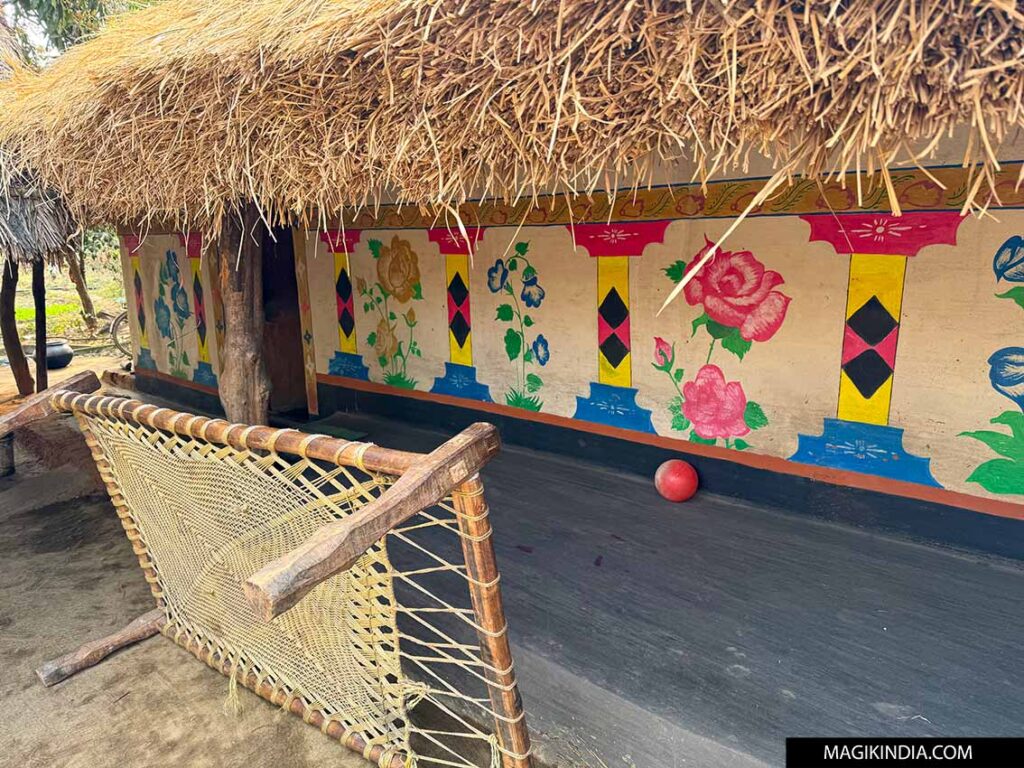
As one moves down to southern Jharkhand and Odisha, artistic expression gains in intensity and freedom. Here, the sobriety of earthy tones gives way to much brighter and bolder hues.

The walls become living frescoes where all creations are permitted. It features stylised pillar motifs, traditional musical instruments and detailed representations of local flora and fauna.

Often, the bottom of the walls is painted with a band of dark color (black or chocolate), while the top remains lighter, creating a very structured visual balance.


While India’s rapid modernisation offers new opportunities, the Santhal people still face deep structural challenges, including land dispossession through mining and persistent economic marginalisation. Yet this resilience is sometimes accompanied by a spectacular political rise: the 2022 election of Droupadi Murmu as President of India. The first personality from the Santhal community to access this position, she embodies historic recognition and a symbol of hope for all the indigenous people of the country.

Vous aimerez peut-être aussi...
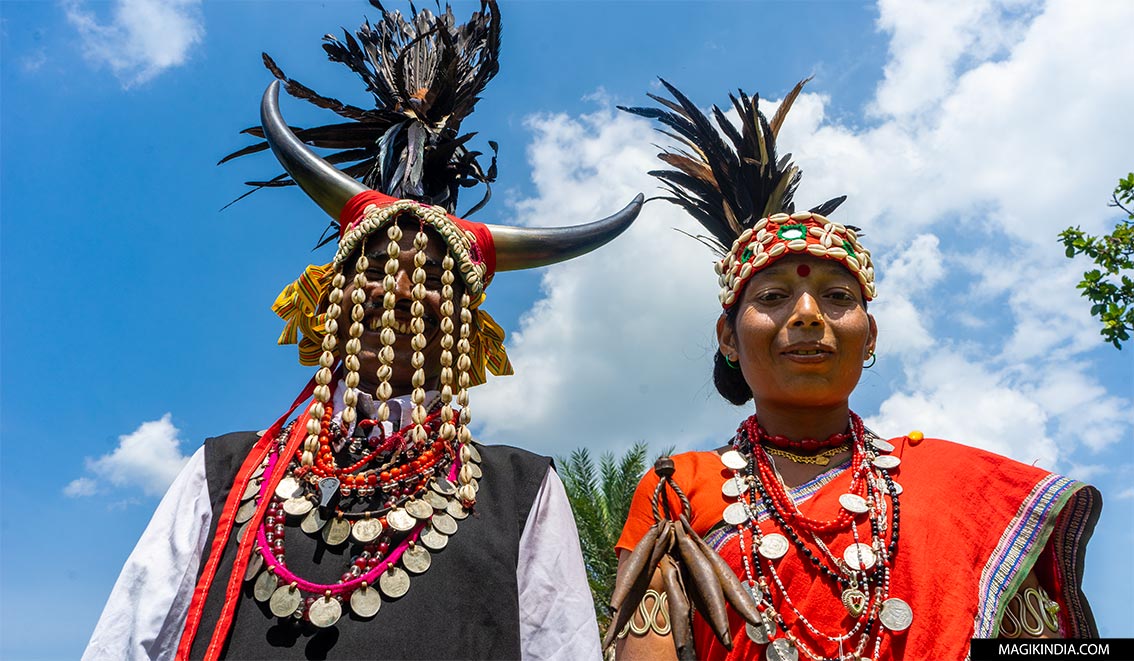
Inhabiting the high plateaus of Bastar (Chhattisgarh), the Dandami Maria tribe constitute an emblematic branch of the Gond people, distinguished...
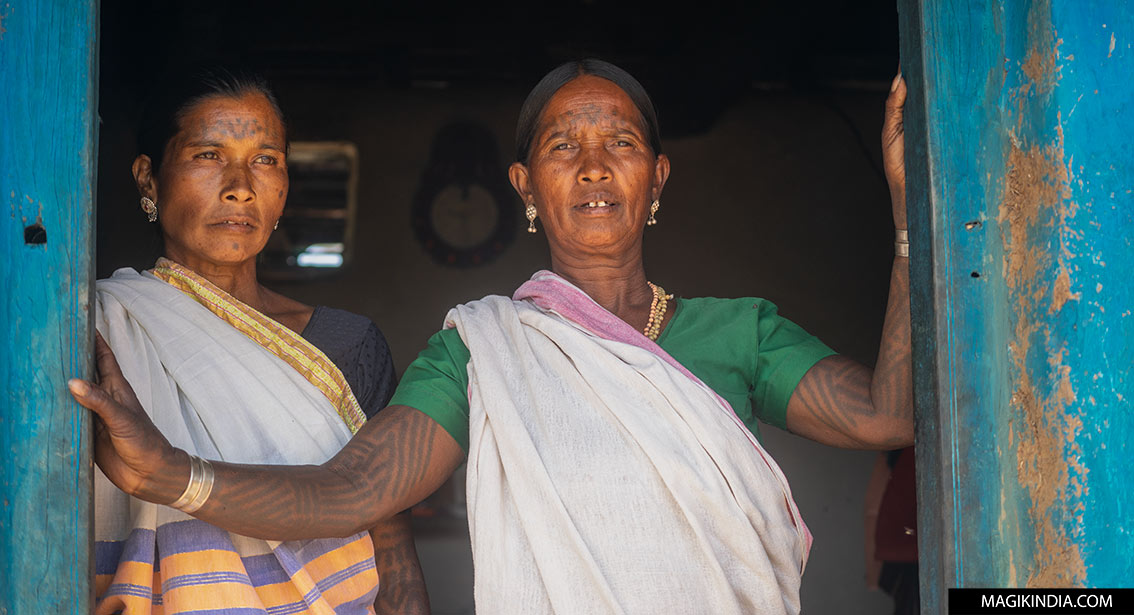
The Baiga tribe, nestled deep within the dense forests of northern Chhattisgarh, define themselves above all as the spiritual guardians...

The Muria tribe, a major branch of the Gond ethnic group, inhabits the highlands and forests of the Bastar district...
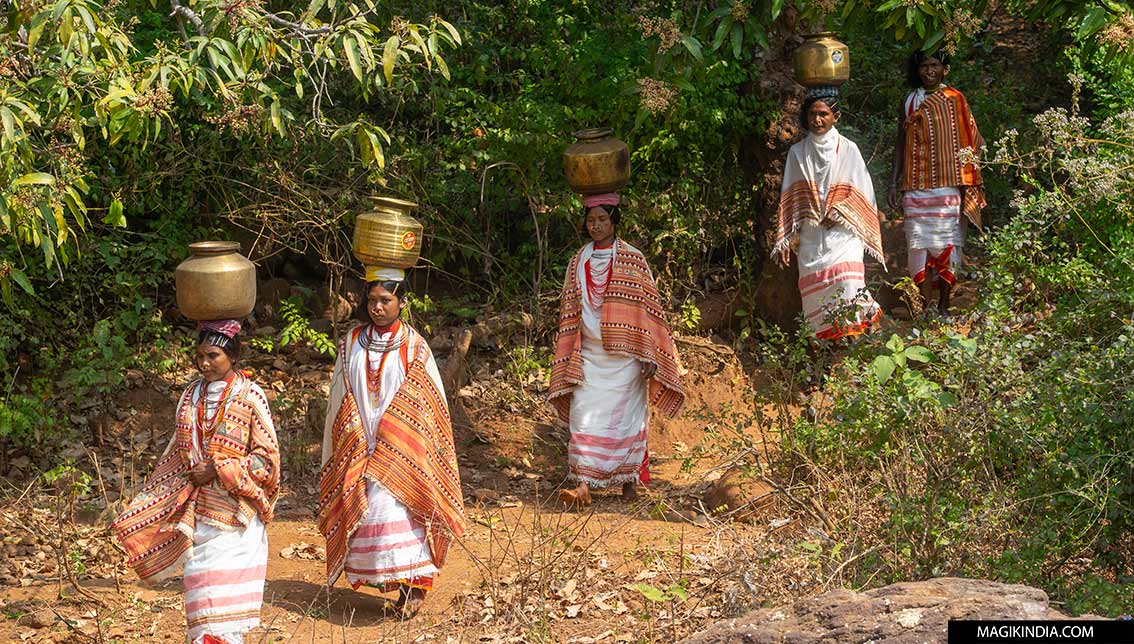
Nestled within the rugged terrain of Odisha’s Niyamgiri Hills, the Dongria Kondh cultivate a sovereign elegance that finds expression as...
Nestled within the rugged folds of the Malkangiri district, on the fringes of the state of Odisha, lives the fascinating...

